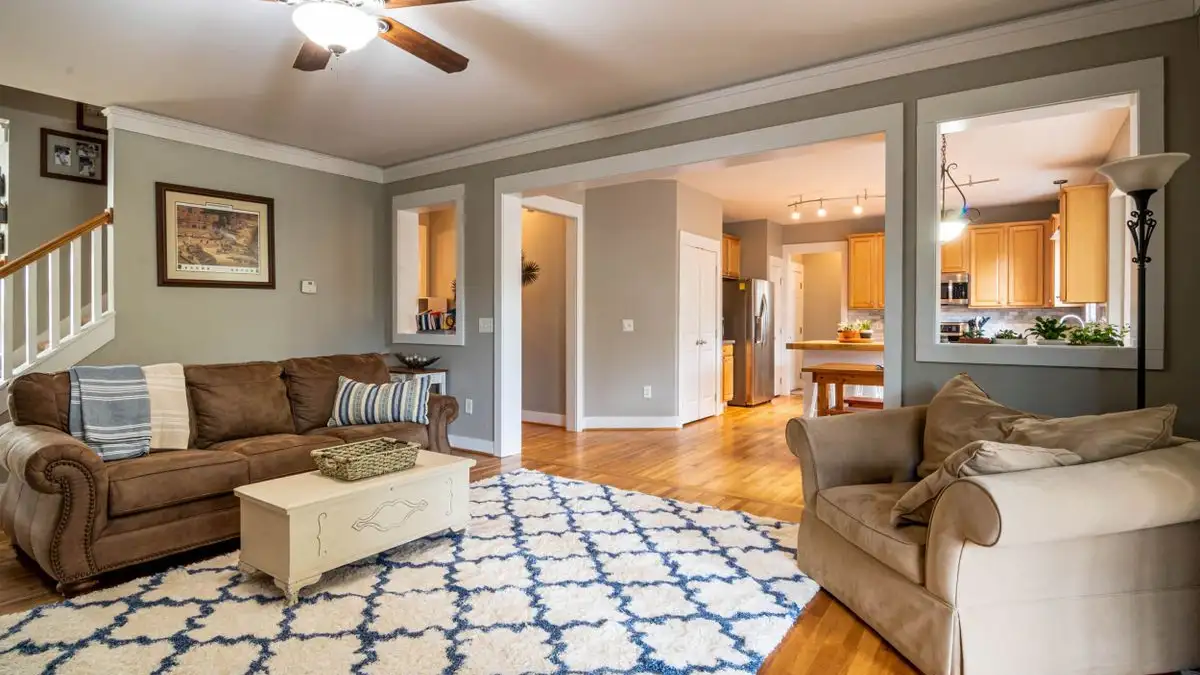
Main walkways through a living room need 36 inches of clear width. Secondary paths can drop to 24 to 30 inches. The way to find out which is which in your own room is to tape the furniture footprints on the floor first, then tape the route you actually walk, then measure the narrowest clear point with a real tape measure — not the average, not the widest spot. The pinch. Rooms almost never fail on average. They fail at one place, usually where a sofa arm or a console table quietly shaves four inches off a path that looked perfectly fine from the doorway.
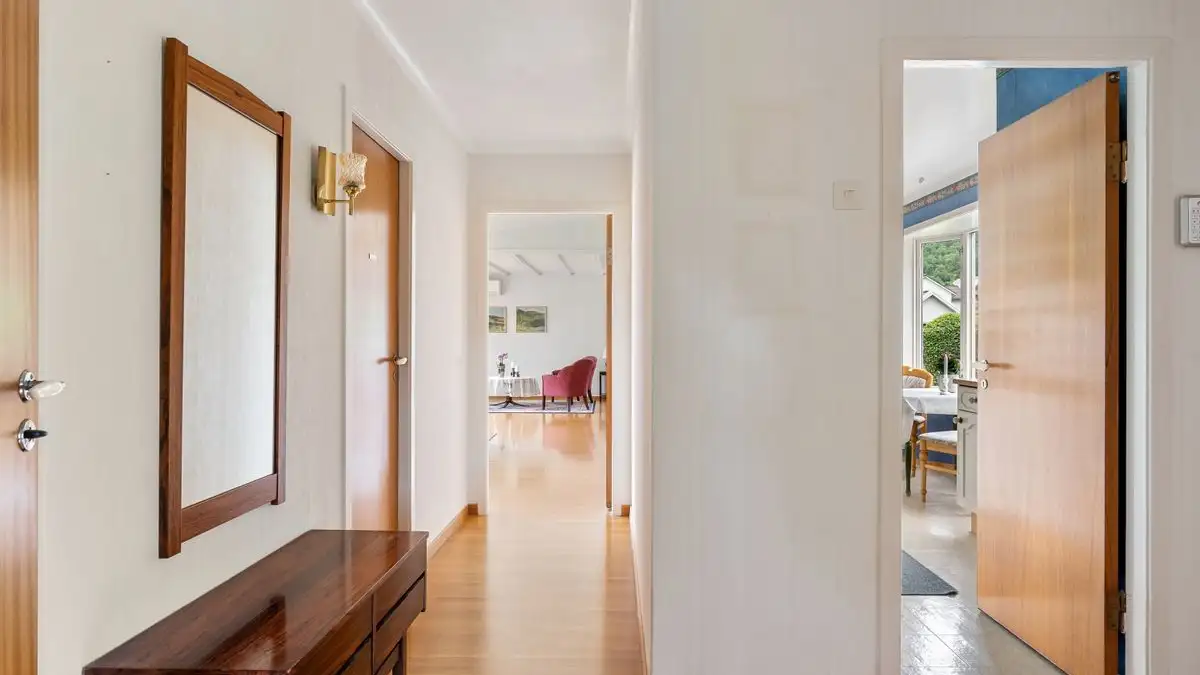
I keep a roll of 2-inch blue painter's tape in the hall closet, and it comes out before anything heavy moves.
Here's what I want you to picture. You're down on the floor, knees on the hardwood, tape roll in one hand and a 25-foot measuring tape in the other. Light is coming across the rug. You peel a strip and press it down where the sofa will sit — front legs, back legs, a rectangle. Then the coffee table. Then the side chair, the console, the bookcase. You're not decorating yet. You're drawing an obstacle course.
Then you stand up and look at what's left.
That leftover shape is the only honest map of your room. A walkway isn't a feature of a living room. It's the residue. Tape the path first and the furniture second and you'll always get the answer you want, because you'll naturally run the tape where it fits instead of where a person walks.
Where the 36 inches actually belongs
It belongs on the route that carries two-way traffic: the line from the door people come in through to the opening on the other side. That's the path where someone entering meets someone leaving, where someone carries a laundry basket, where a guest follows you in from the kitchen. Give that one 36 inches and don't negotiate it.
Everything else can be secondary. The gap behind the sofa, the squeeze along the window wall, the way around the back of a reading chair — those can live at 24 to 30 inches and still feel fine. A 24-inch path is a path. You just can't pass anyone in it.
There's usually exactly one route in a living room that earns the full 36. Try to give every gap 36 inches and you end up with a room that has no furniture in it and a very smug tape measure.
Measure the pinch, not the average
Once the tape is down, measure across each remaining gap perpendicular to the direction of travel. Square across, not at an angle. An angled measurement flatters you by two or three inches every single time, and that's exactly the error that turns a 31-inch choke into a "roughly 34" in your head.
Now the part most people get wrong: you don't average. If the path runs 40 inches for six feet and then 31 inches where the sofa arm sticks out, your walkway is 31 inches. One pinch defines the whole run. It's the number that decides whether two people can pass, and it's the number nobody measures, because from the doorway the room looks fine and the tape measure is in a drawer.
If you have carpet with any pile left, you already have a drawing of this. Look at the flattened lane in the pile before you plan anything. If the wear runs diagonally from the entry to the far corner, that's your main path — not the tidy right angle you had in mind. Trust the carpet. It's a record of a thousand trips you didn't plan.
The seating numbers, and what they're actually for
These aren't style rules. They're legroom and passage distances, and each one solves a specific collision.
- Front edge of the sofa to the coffee table: 14 to 18 inches. Below 14 you're turning sideways to get past your own table with a mug in your hand.
- Between facing chairs, or between a sofa and a side chair at an angle: 18 to 24 inches. This is the distance where a conversation area stops feeling like a waiting room, and it's also the minimum a person needs to stand up out of a chair without scraping knees.
- For TV viewing, a common guideline is to sit roughly 1.5 to 2.5 times the screen's diagonal measurement away. On a large screen that distance is long, and the room has to be able to absorb it without pushing the seating into your 36-inch path.
Notice how these interact. Widening the coffee table gap to 18 inches narrows the walkway behind it by the same 4 inches. There's no free space in a living room. Every inch you give one gap comes out of another, which is why the tape goes down before the decision, not after.
The things you can't move out of the way
A few clearances aren't about comfort at all. They're about function, and no furniture arrangement gets you out of them.
Door swings first. A 32-inch door needs 32 inches of arc while it's open, and it takes that arc out of your path. Tape the quarter circle on the floor and see where it lands. If it lands on the sofa, the sofa moves, not the door.
The path to a patio door counts as a main path even if the door gets used four months a year. It's the route guests take, it's often the route with a tray in both hands, and it's the one people forget to check because they check it in February.
Floor vents and baseboard heaters need to stay uncovered — a sofa pushed flat against a supply register kills the airflow to the whole room and you'll feel it by January. In practice that means a few inches of standoff, not a full walkway, but it's a clearance you have to draw.
When 36 inches isn't possible
Some rooms can't give you 36 anywhere. A chimney breast, a radiator, a doorway that's narrower than the wall around it, a stair landing that eats a corner. I've taped rooms where the widest single gap was 33 inches and no amount of rearranging changed it.
In that case you don't shrink the path. You shrink the furniture. Pick the one route that has to work — almost always the entry-to-exit line — protect it as best you can, and then reduce what's sitting in the room until that route clears. A 30-inch path that everyone actually uses is a worse room than a 36-inch path with a smaller sofa and one fewer chair. The tape will tell you which one you have.
Leave the tape down for a week
The real test isn't the measurement, it's the week. Leave the strips on the floor and live in the room. Walk it with an armload of laundry. Have someone come toward you from the other side and see whether one of you has to turn sideways. Watch where the dog cuts the corner, because the dog is taking the shortest possible line and so is everyone else once the tape is gone.
Painter's tape is cheap and it peels off clean. A sofa you have to sidestep for the next eight years is not. Measure the pinch, not the average, and you'll know where your 36 inches go before anything heavy moves.