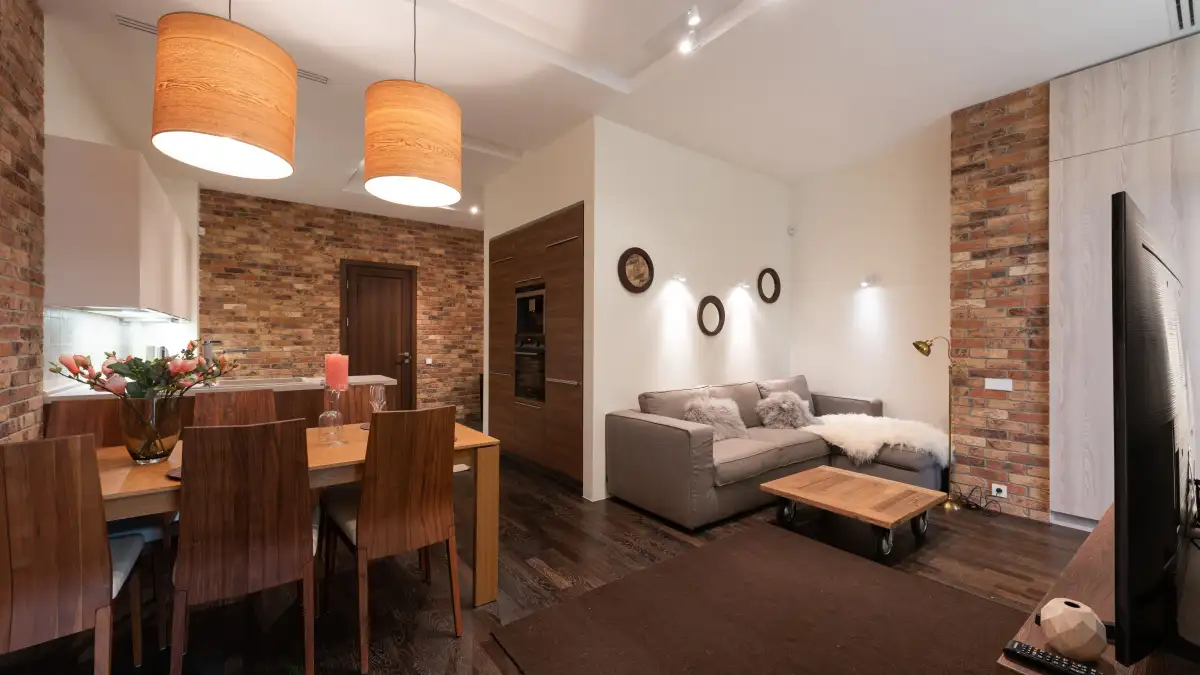
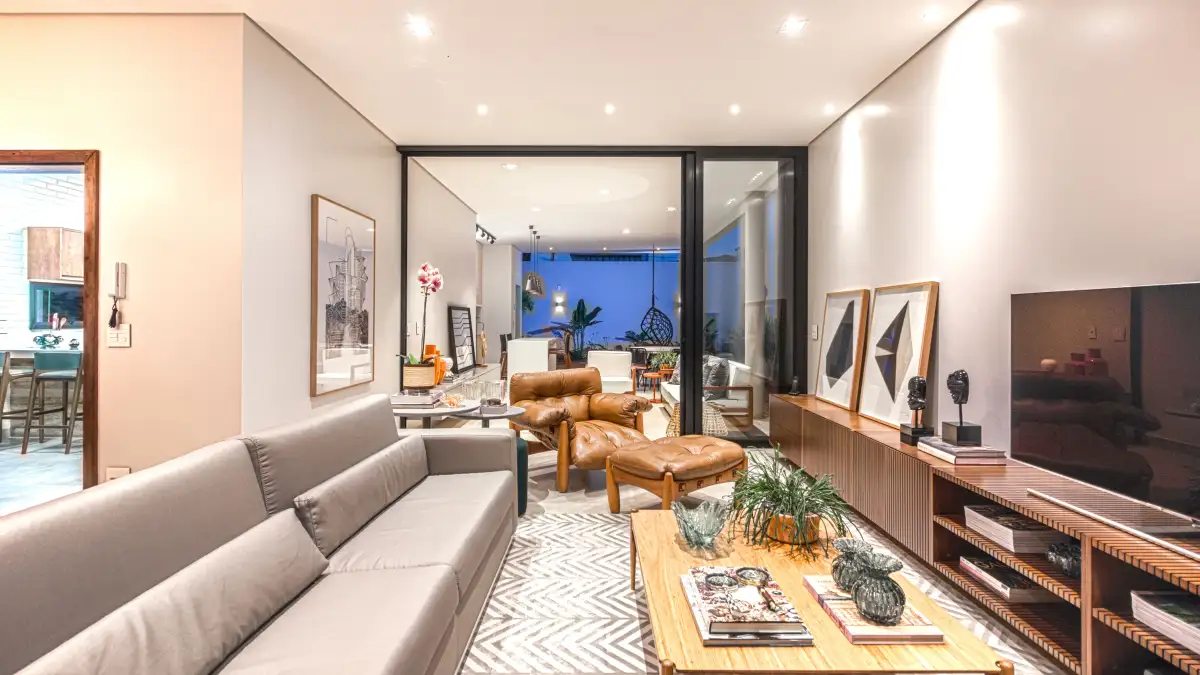
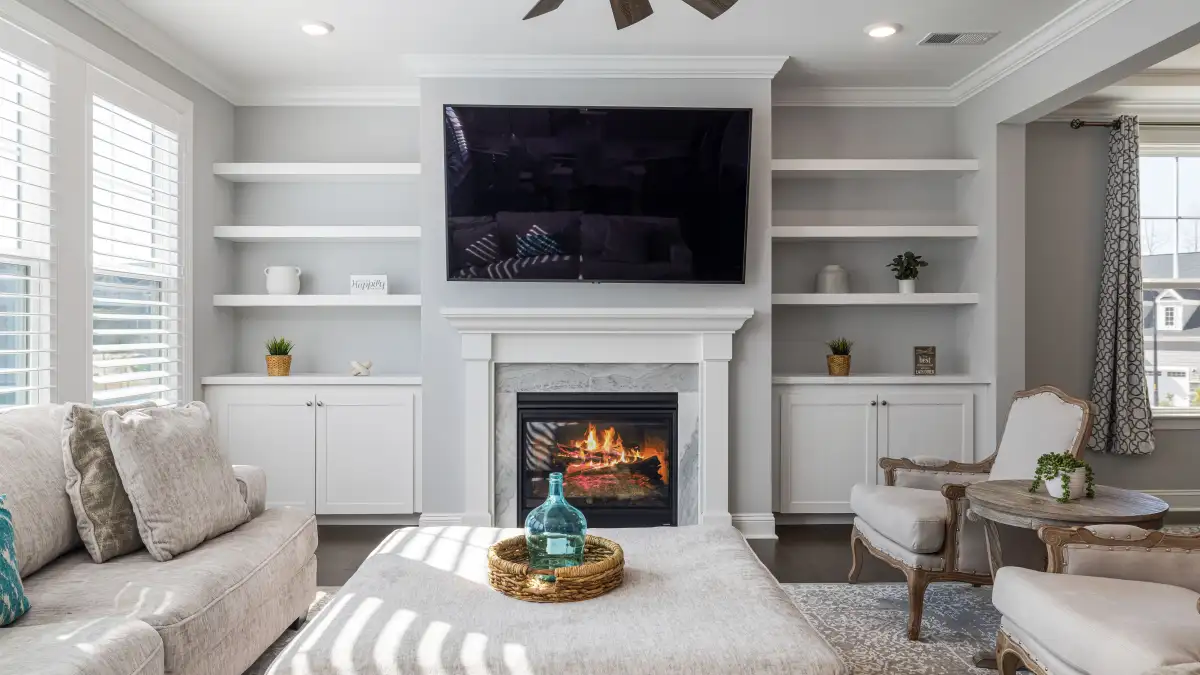
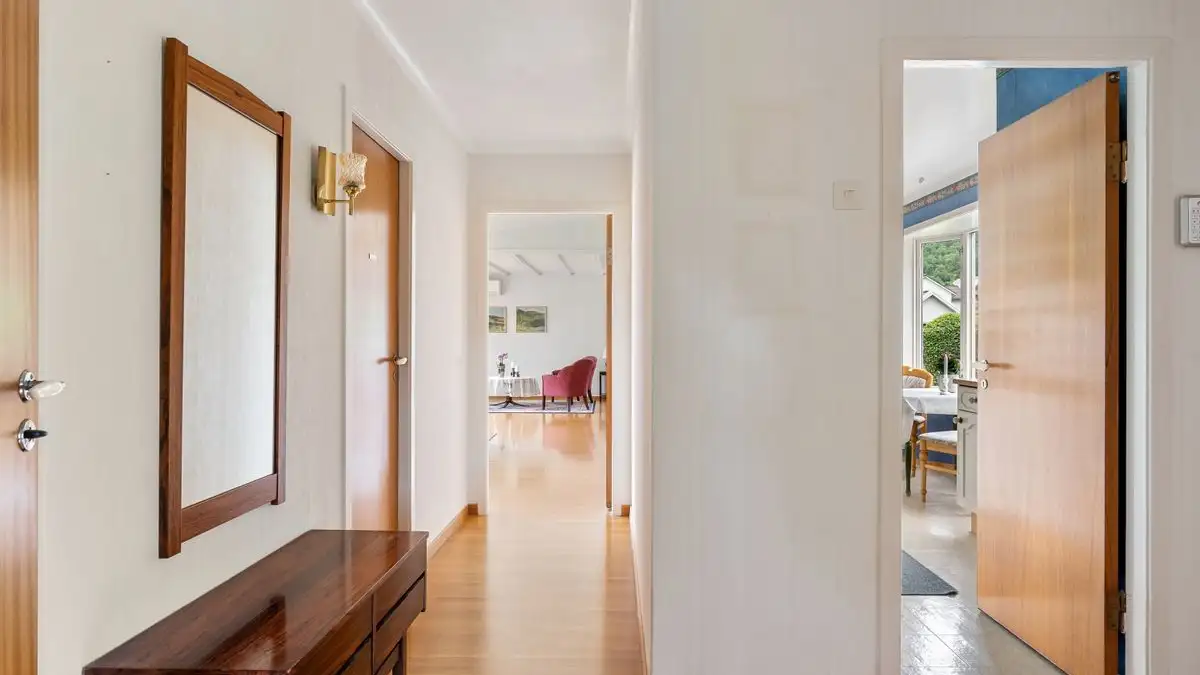
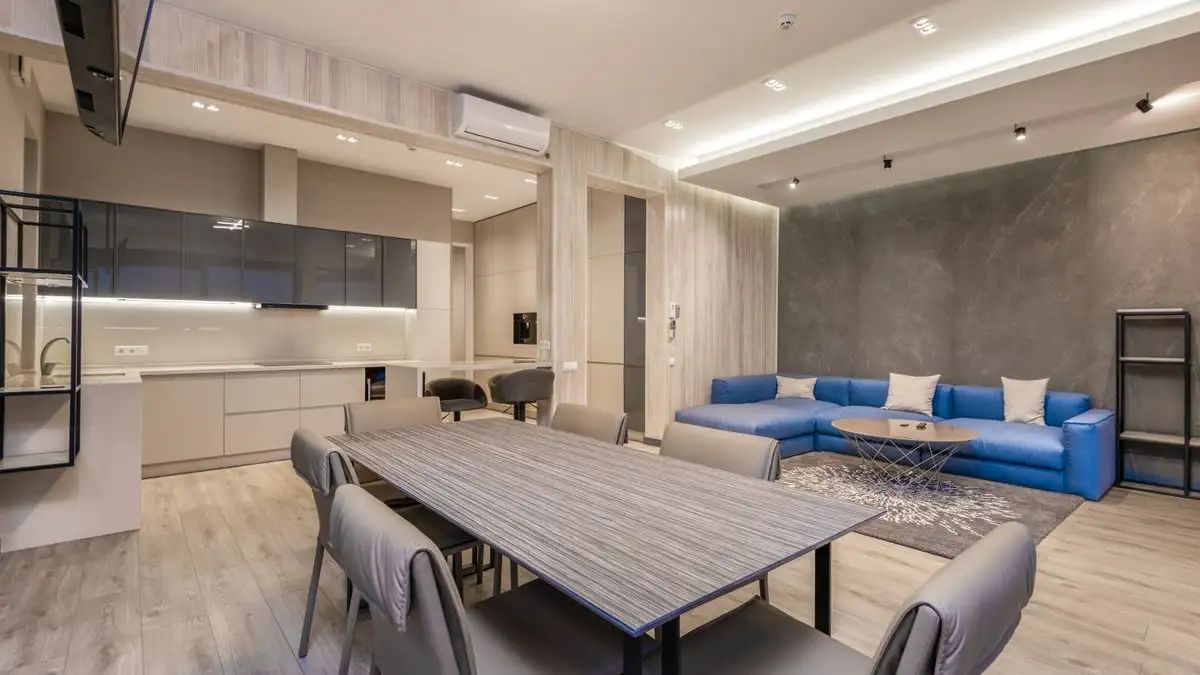
Size the rug to the seating group and the walkways it creates, not to the coffee table. When a living room reads smaller than its square footage, an undersized rug is usually the reason: the eye takes the rug's edge as the edge of the room, and furniture standing on bare floor beyond that edge registers as leftover space. Three numbers handle most of it. An 8x10 rug suits a sofa up to about 7 feet long, and a 9x12 takes over once a sectional or a genuinely large room is in play. At least the front legs of every main seating piece should land on the rug. And along the routes people actually walk, 6 to 10 inches of bare floor should show between the rug's edge and the wall.
The night I stopped sitting and started looking
I stood at the back of my own living room one night with a glass of water, looking toward the sofa instead of sitting on it, and the arrangement had come apart without anyone deciding to take it apart.
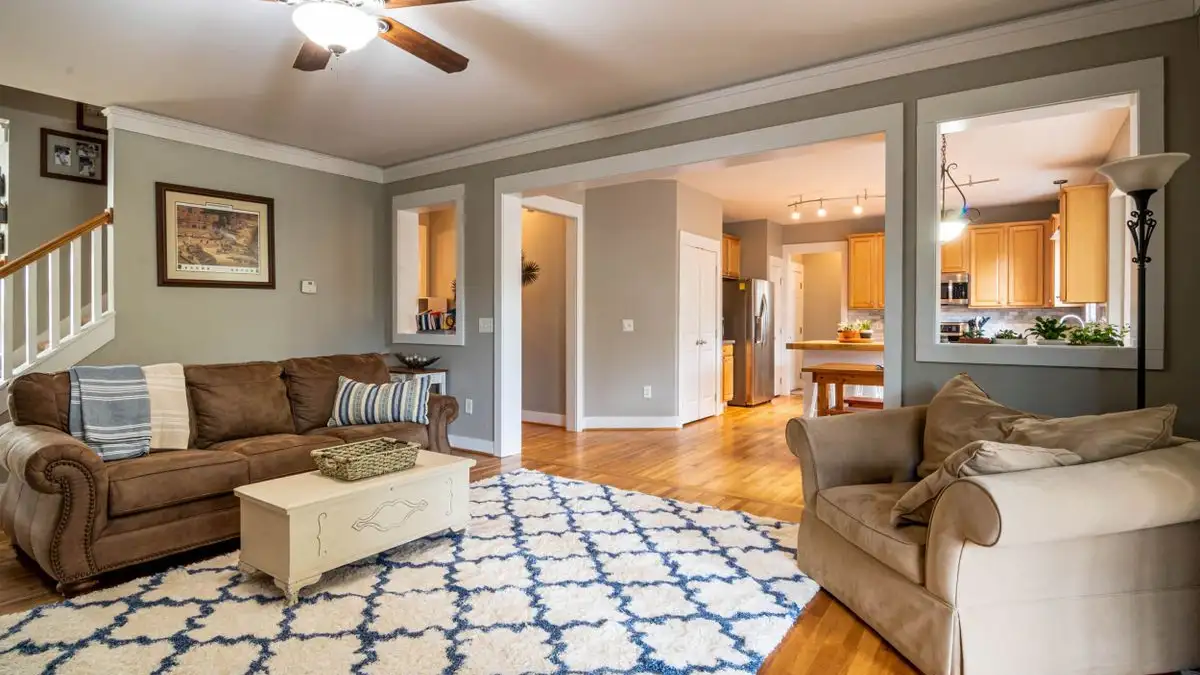
The rug had crept toward the fireplace over the winter. The two armchairs had drifted the other way, an inch at a time, the way chairs do when you push back to stand up. Somewhere in those two small movements the chairs had left the rug almost entirely, one back leg still riding the edge, and the coffee table now sat in a wide open field of rug with the chairs orbiting outside it.
Walking back to the kitchen, my heel caught the rug's corner. That is the part that gets left out of most rug advice: a too-small rug doesn't just look wrong, it moves. Every catch drags it another inch, and the group shrinks a little more.
So I got the tape measure out of the drawer, and I measured the sofa instead of the room.
Measure the sofa before you measure the room
The room tells you what's possible. The sofa tells you what's required, and the required number is the one that picks the rug.
I run the tape along the front of the sofa, arm to arm, and write the number down. Seven feet is 84 inches. Then I do the same for the rug: an 8x10 is 96 inches one way and 120 the other. Lay the sofa along the 96-inch side and that leaves 12 inches, split into 6 inches of rug at each arm. Which is the minimum. It works, and it forgives nothing, because a sofa listed as 7 feet can measure 86 or 88 inches once the arms are counted, and that eats most of the margin. A 9x12 runs 108 by 144, so the same sofa gets a foot of rug at each end plus two extra feet of depth reaching toward the chairs. That is the difference people are feeling when they say the bigger rug made the room work.
Then the second measurement, which matters just as much: from the front of the sofa to the front edge of the chairs facing it. Add the 6 to 10 inches of rug you want under the sofa's front legs, and that total is the depth the rug has to cover. If it comes out longer than the rug's long side, the chairs are simply too far off. No rug size rescues a group that spread out too wide. The fix is to pull the chairs in and measure again, not to buy a rug the size of the room.
Two numbers, then. Sofa length for width. Sofa-to-chair distance for depth.
Before anything gets ordered, I mark the rectangle on the floor in painter's tape and leave it there for a day. The tape tells me what a floor plan can't: whether the gap at the walkway survives when I'm actually carrying a laundry basket through it.
Front legs, all four legs, and the thing that breaks the group
The rule I keep: at least the front legs of every main seating piece on the rug. The sofa. The loveseat, if there is one. The two chairs that face the sofa. Not the side table, not the floor lamp, not the plant in the corner. Those can sit on bare floor and the room still reads as one arrangement, because the rug is anchoring what you sit on, not what you set down.
Why front legs rather than some margin around the coffee table? Because the front legs are where a chair meets the floor with weight, and the eye follows them down. A chair with its front legs off the rug stops belonging to the group and becomes furniture that happens to be nearby. Do that with two chairs at once and you've built two islands: a rug island and an orphan corner.
In a large room, put all four legs on. It costs nothing and it makes the sofa look placed rather than pushed against the rug's edge. In a small room, front legs only is a legitimate compromise, and the chairs can still be fully on while the sofa rides the edge.
Here is the test. Stand in the doorway, or at the far end of the room, and look at the group as a shape rather than as objects. If the rug's edge cuts through the middle of it, right through the middle of those facing chairs, the arrangement is split. Move the rug or move the chairs. At that point the size of the rug stops mattering.
The strip along the wall is doing more work than the rug
Measure from the wall toward the middle of the room and mark 6 inches with a piece of tape. Mark 10 inches the same way. On any side where people walk, the rug's edge should land between those two marks.
Under 6 inches and the gap reads as a mistake, like carpet that came up short of the wall. Over 10 inches in an ordinary room and the rug looks like it's drifting away from the room it's supposed to hold. In a genuinely large room, say 18 feet across, push the reveal to 12 or 18 inches and let the floor show. A big rug with a stingy 6-inch border starts to read as wall-to-wall carpeting that shrank.
The tradeoff that makes this hard
Every inch you give the walkway you take from the rug's reach, and the reach is what gets the chairs' front legs onto the rug.
That is the real tension in a narrow living room, and it is why the room feels cramped no matter what goes on the floor. You can't fix both ends at once with the wrong rug. What you can do is decide which matters more in that particular room. If the walkway is the through-route to the kitchen, protect the walkway and pull the seating in tighter, because a small tight group beats a spread-out one whose rug stops mid-chair. If that strip along the wall is a dead end nobody uses, cheat the gap to 4 inches and spend the difference on depth.
Floating seating, open plans, and the edge nobody watches
A seating area that floats in the middle of the floor, with no sofa against a wall, needs the rug to extend at least 6 inches past each end of the sofa, not just under its front legs. Those 6 inches are what make the rug look chosen for the furniture instead of handed down from another room.
In an open plan, the rug is doing a different job: it marks where the living zone ends before the dining zone begins. The catch is that the boundary should never be a free-floating edge lying across a walking path. Two ways to avoid that. Run the rug's long edge parallel to the path, so the eye reads a line instead of a step. Or end the rug underneath something, flush with the back of the sofa with the sofa sitting on those last few inches, so the boundary is the sofa itself and not a rug edge.
Then there's the shortcut. People cut corners across a room. If the diagonal they take crosses the rug's corner, they'll catch it, the rug will shift, and within a season the group has quietly shrunk back to where it started. If you can see a natural diagonal path across the rug, move the rug so its corner isn't sitting in that path, or give that corner enough furniture weight that it stops wandering.
When the rug you already own is the wrong size
Most people aren't starting from nothing. They're working with a rug already on the floor, and the useful question isn't which rug to buy. It's which of these four moves to make.
Move the furniture to the rug. Pull the chairs in until their front legs are on it. Lose the side table if that's the thing holding the gap open. This is the cheapest fix and the one that works most often. A tight group on a right-sized rug beats a wide group on an undersized one every single time.
Rotate it. A rug that reads short in one direction sometimes has the depth you need the other way, and rotating costs nothing but an afternoon.
Drop a piece. If the rug can't reach the front legs of both chairs, then the room has space for one chair and a floor lamp, not two chairs. One chair fully on the rug looks better than two chairs half off it.
Buy bigger, and buy it after the tape measure rather than before. What I'd avoid is adding a second small rug under the chairs to stretch the reach, unless you're committing to a deliberate two-rug arrangement in a very long room. Half-done, it reads as two rugs arguing with each other.
Rugs move, so re-measure
The shrinking is rarely a purchase problem. It's a drift problem. Rugs slide on hard floors, chairs get pushed back, and a group that was correct in October can be two inches off by March. I keep a small mark on the floor at the two front corners of the rug, a pencil tick or a scrap of painter's tape, so I can see at a glance whether anything has walked. Ten seconds.
When it has, I don't re-shop. I slide the rug back under the sofa's front legs, nudge the chairs on, and walk the room once from the doorway to the far wall to confirm the path still feels like a path.
The room never got bigger. The rug just stopped drawing a smaller room inside it.