Overpaying? How to Get Cellular Blinds’ Savings Without the Price
The expensive choice isn’t the blind with the higher price tag. It’s the one that leaks money out the window every month. Choosing Roman shades without accounting for the energy they fail to trap can add over $400 to your total cost across a few years. That’s the error most side-by-side price comparisons conceal.
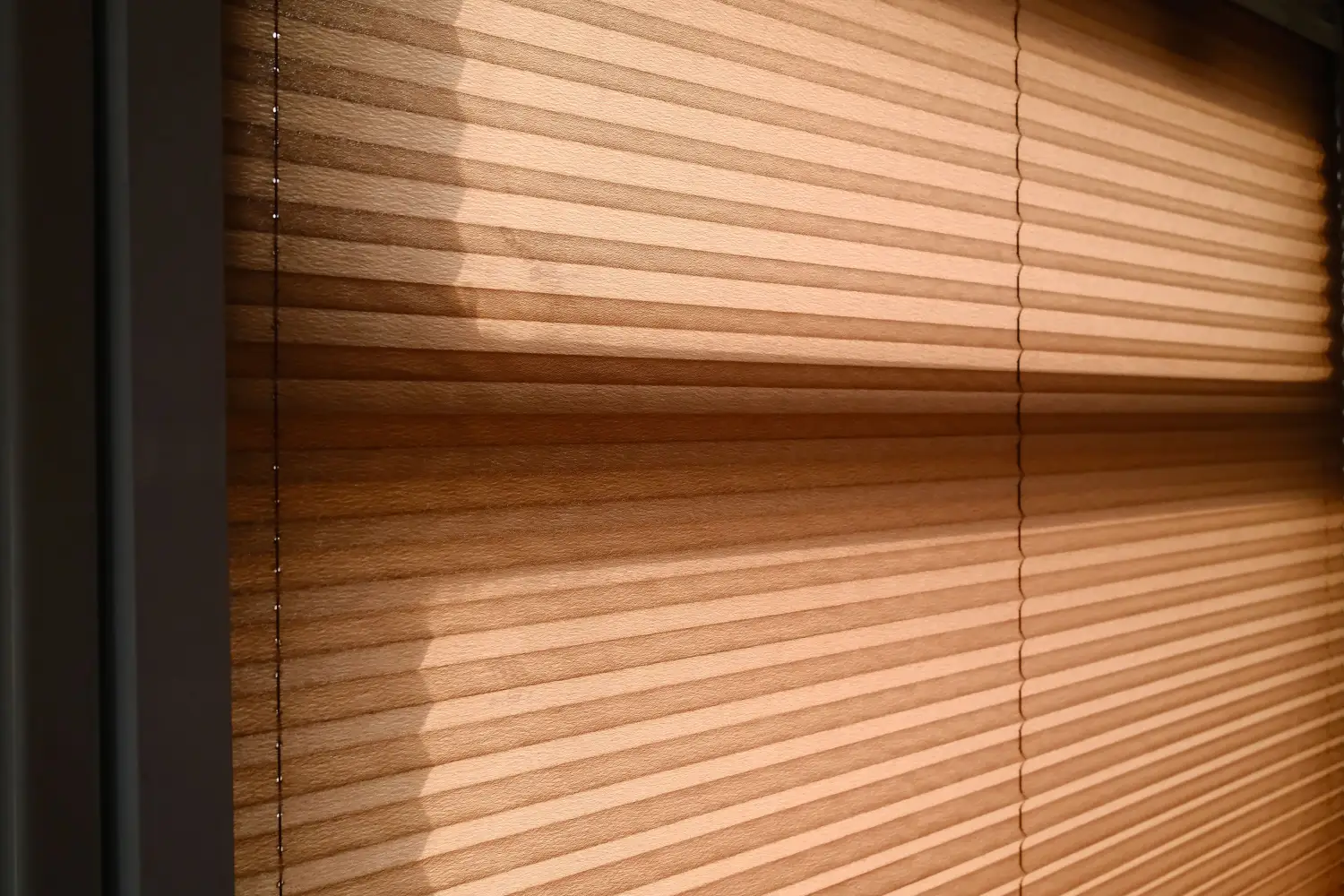
Cellular blinds work because of their honeycomb pockets: they create dead-air barriers that slow heat transfer through the glass — the single largest thermal hole in a wall. Roman shades, unless purpose-built with thermal interlining, stop almost none of this. The immediate savings sit on your utility bill, and after five to seven normal years, what looked like the pricier option at checkout has already paid you back.
Where the $400 Error Happens: Scenario Comparison
| Common Scenario | Winner for Total Cost | One-Line Reason |
|---|---|---|
| Drafty, older windows with a long-term owner | Cellular blinds | $10–$25 annual per-window savings erase the higher upfront cost within 3 years |
| You’re renting or moving in under 2 years | Roman shades | You won’t stay long enough to capture any energy payback |
| You want a formal, flat-front look with no visible pleats | Roman shades (caveat) | Aesthetics win, but you’ll pay more in lost energy unless you spec a thermal liner |
| Blackout darkness in a bedroom or nursery | Cellular blinds (blackout option) | The added insulation reduces draft noise and HVAC load while blocking light |
| Materials-only budget under $60 per window | Roman shades (basic fabric) | Entry-level cellular blinds start higher; cheap Romans dominate on upfront price |
When Drafts and Utility Bills Are the Real Problem
This is where the logic is clearest. Single-pane windows, gaps around the sash, a room that won’t hold heat — a cellular blind isn’t decoration here; it’s a functional layer that pays for itself.
The Department of Energy’s research shows cellular shades can cut window heat loss by up to 40%. A standard 3’×5’ window in a heating climate might waste $20–$30 per season. A Roman shade blocks some radiant loss but contributes almost nothing to conductive insulation. The math: live with the Roman shade and you keep paying that leakage. Install a cellular blind and the return starts in year two or three; after that it’s pure savings.
What you give up: cellular blinds have a visible pleat structure when raised. They lack the smooth drape of a Roman shade. If the space is your formal dining room and thermal performance is secondary, that trade-off may not be rational.
When Looks Dictate the Decision
Roman shades offer crisp folds, rich fabrics, and a refined drop that suits a carefully designed room. In a well-sealed home with low heating demands, the visual advantage can outweigh the energy gap.
Still, the full cost includes the utility expense you absorb. Without thermal lining, a Roman shade leaves the window largely uninsulated. In mild climates, the annual loss might be $5 per window — trivial. In a sunroom with three walls of glass or a bedroom over an unheated garage, skipping insulation is slow financial damage. If aesthetics are the priority, the disciplined choice is to price a Roman shade with a thermal interlining added. It raises the upfront cost but cuts the performance gap enough to avoid the worst of the mistake.
What you give up: cellular blinds lack the decorative fabric variety. Accept that you’re buying a higher total cost of ownership for the look you want.
When You’ll Be Gone Before the Savings Arrive
Short occupancy resets the equation. A renter or someone selling within two years won’t see the cumulative energy return. Lowest upfront price wins. Basic Roman shades can start at $30–$40 per window; cellular blinds rarely dip below $50. Spend less now, and the next person owns the energy bill — the $400 mistake becomes theirs.
What you give up: you endure colder glass and a slightly higher utility cost for the duration. In an exceptionally drafty apartment, a budget cellular blind might still pay back in one brutal winter, but you must calculate that case by case.
What’s Not Worth Stressing Over
Some comparisons are false choices. Dismiss them.
Light filtering: both categories span sheer to room-darkening. You can match opacity either way.
Cleaning: dust settles on both; spot-cleaning works on both. No decisive advantage.
Cordless and motorized capability: widely available for both, with similar reliability and markup.
Privacy: both cover the glass completely when lowered. No meaningful gap.
Sound dampening: cellular blinds have a small edge from their air pockets, but the difference is too minor to guide a purchase.
Stop weighing these. Put your attention on insulation payback and how the blind looks in the room.
Hard Barriers: When One Option Fails
Certain requirements eliminate a product immediately.
Cellular blinds become impossible when:
- The window is unusually wide (past 96 inches) or an irregular shape like an arch — the pleated structure resists custom fabrication, while Roman shades can be built to nearly any dimension.
- You need an exact woven texture or a specific fabric swatch to match upholstery. Roman shades accept endless fabrics; cellular blinds stick to polyester-based options.
Roman shades become impossible when:
- The window sits in an unconditioned space — sunroom, three-season porch, unheated basement — where insulation isn’t optional. Even a thermal-lined Roman shade won’t approach a double-cell honeycomb shade at stopping drafts.
- You have small children or pets and need a cordless blind that also eliminates dangling fabric loops; cellular blinds pack tighter and present fewer snagging hazards.
The Real Cost Calculation
The upfront numbers only tell half the story.
Typical installed cost per standard 30″×60″ window:
- Basic single-cell cellular blind (light filtering): $55–$75
- Mid-range fabric Roman shade (cordless): $80–$120
Annual energy savings from a cellular blind in a home with older, drafty windows: roughly $10–$25 per window, varying by climate and fuel type. In cold regions, expect the high end. In coastal mild zones, closer to $5.
Five-year view:
- Cellular blind: $65 upfront – $75 saved (five years at $15/year) = net negative — you’re $10 ahead.
- Roman shade: $100 upfront + $0 saved = total cost $100.
The $400 mistake surfaces across a whole house. Ten windows, each saving $75 over five years, means $750 you never recovered. Even with conservative estimates, a typical home misses $400–$600 in avoided utility costs.
Answers to the Questions You’re Actually Typing
Do cellular blinds save enough to make swapping out Roman shades worthwhile?
Yes, when windows are single-pane or leaky. Stand near the glass on a cold day and feel the draft; if your current blind does nothing to stop it, cellular shades will make a measurable difference. In a tight double-pane home, the savings shrink and may not justify the switch.
Can I put a thermal liner in a Roman shade and get similar insulation?
You’ll improve it, but not match it. A thermal blackout liner adds some R-value, yet lacks the multiple trapped-air cells that give cellular blinds their edge. Expect maybe half the benefit — useful, but not equivalent.
Are there cellular blinds that look like Roman shades?
Yes. Several brands produce Roman-style cellular shades — front folds that resemble a flat panel when lowered, with honeycomb cells hidden inside. They cost more than standard cellulars, and the fold reduces stack height. If you want the appearance without the energy penalty, this is the rational compromise.
How do I know if I’ll stay long enough to break even?
Take a recent utility bill, estimate the window share of your heating/cooling load (often 25–30%), then assume cellular blinds cut that window loss by 30–40%. Multiply the annual dollar figure by your planned years. If it exceeds the price gap, cellular wins. With a two-year rental horizon, the answer is almost always no.
For the majority of homes with older windows, cellular blinds are the cheaper choice once the hidden cost of lost energy is counted. The single question to ask: over the entire lifespan of this blind, which costs me less — a modest purchase price now, or the bill I’ll keep paying every month?

Clara Bennett
After five years of transforming my 1920s bungalow room by room, I’ve refinished floors, hung blinds in bay windows, and spent more time choosing light bulbs than I’d like to admit. I learned paint sheens by painting my kitchen ceiling three times, and I found out the hard way that a rug too small makes a room feel unfinished. I believe every home can be both functional and beautiful, no matter the budget.
Related posts
Roman Shades vs Cellular Blinds: The One Number That Settles It
Multiply sunlight hours by insulation need to find the clear winner. Our no‑nonsense guide calculates the four numbers every homeowner needs before buying blinds.
The Cleaning Mistake That Ruins Roman Shades (And How to Avoid It)
Stop using water on Roman shades—that's the cleaning mistake that ruins the folds and backing. Learn how often to vacuum, how to spot-clean safely, and what to avoid.
R-Values: Roman Shades vs Cellular Blinds — 3 Crucial Numbers
Stop guessing. See exactly how much insulation a cellular blind adds vs a Roman shade on a 3x5 window. R-values from R-1 to R-4.5 compared.
Roman Shades Are Outdated? The Cellular Blind Design That’s Sleeker
Roman shades aren't always outdated, but a modern cordless cellular blind hides hardware and looks cleaner. See when to use each and the one style that feels fresh.

The Blackout Problem: Why Roman Shades Fail at 5 AM Every Morning
Roman shades marketed as blackout leak light at dawn because they lack side channels. See exactly why and how cellular blinds with tracks deliver the darkness you expect.