Are Your Bedroom Windows Quietly Undermining Your Sleep?
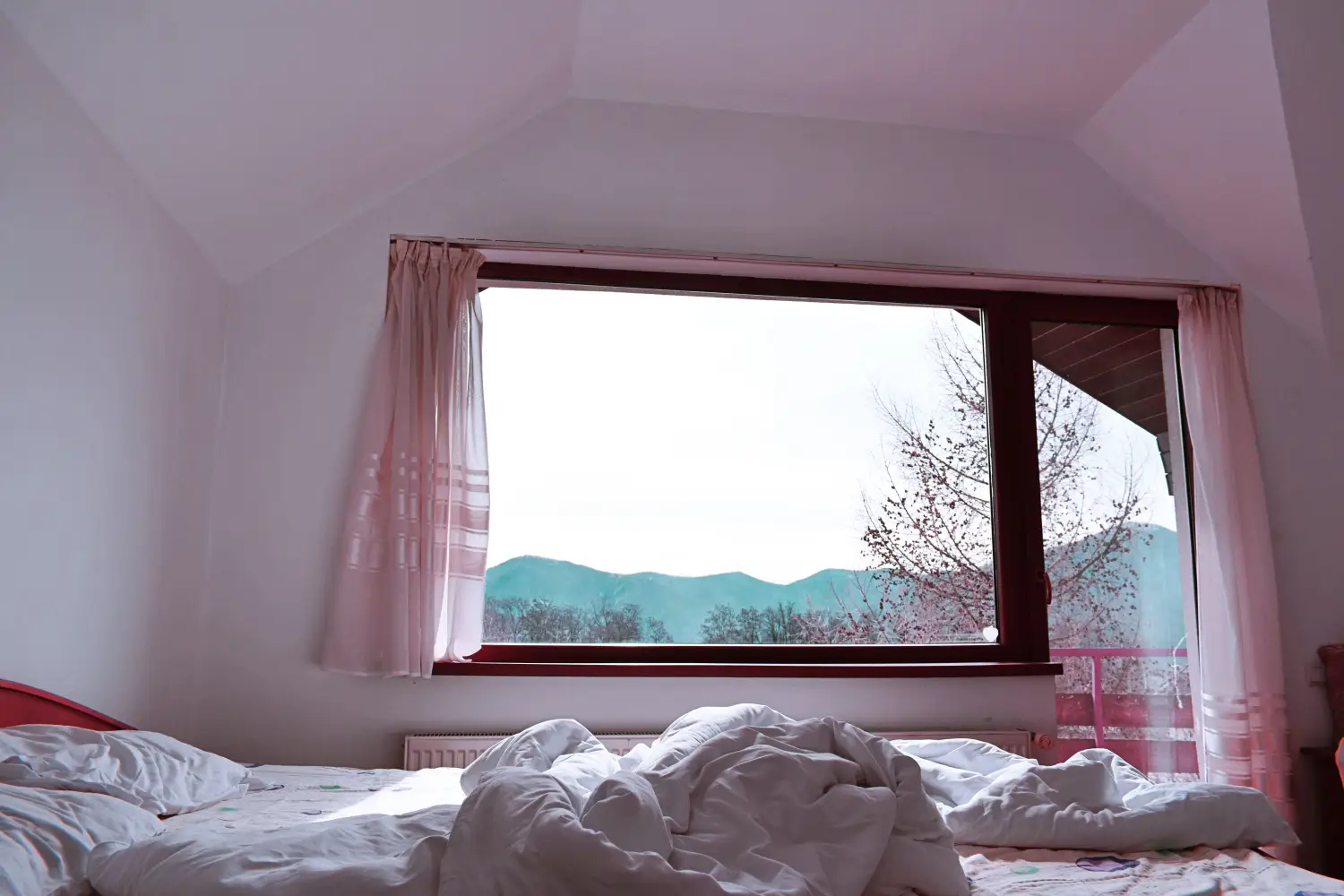
If your windows let in uncontrolled light or temperature swings, they are quietly undermining your sleep. The answer is not just buying the first blackout curtain you see online. Fixing this means treating window coverings as a sleep-hygiene intervention—one where you choose opacity, mounting, and safety as a sequence, not a grab bag. This guide lays out a three-part decision tree that prioritizes light blocking and thermal comfort over style gimmicks, so you end up with a covering that actually does its job.
Light and Temperature: The Two Forces at Your Window
Bedroom windows disrupt sleep through two hard physical facts. Light—even a sliver of streetlight or early sun—hits the retina and suppresses melatonin, the hormone that tells your body to stay asleep. The effect is dose-dependent; a small amount of blue-wavelength light at 4 a.m. can be enough. Temperature fluctuations work differently. A cold draft in winter or heat radiating through glass on a summer evening can pull you out of deep sleep just as reliably as a noise, because your body needs stable thermal conditions to stay in REM.
Window coverings are the most direct counter you have. But a sheer curtain is useless for both light and temperature. A blackout curtain with the wrong mount leaves a bright halo around the edges. And a heavy dark drape that turns the window into a heater on a hot night creates a temperature problem while solving the light one. The decision tree below treats opacity, mounting, and safety as separate levers you must set correctly to get a result that actually works for sleep.
Opacity First: What Level of Light Blocking Do You Need?
Before you look at color or fabric, decide how much light the covering must stop. The scale runs from sheer to blackout, and each tier has a clear job. Sheer fabrics diffuse light but block almost none; they are useless for sleep. Light-filtering materials soften glare and add daytime privacy, but they can still let in enough brightness from a streetlight to be distracting. Room-darkening fabrics block about 90–95% of exterior light—enough for someone who sleeps fine in moderate darkness, but not for a person who needs a pitch-black room. Blackout materials block 99–100% of visible light; this is what you choose when even the glow of a digital clock feels intrusive.
The decision hinges on your sleeping window. If the room faces east and you need to sleep past sunrise, blackout is the baseline. If the only light source is a distant porch light that doesn’t bother you, room-darkening may do the job. What “done well” looks like: You test the fabric sample against the actual window at the hour you sleep—not midday. And you think about heat. A dark-colored blackout fabric on a sun-hit window absorbs and radiates heat into the room. A lighter back or a cellular shade with reflective properties can block light without turning the bedroom into an oven.
Mounting Method: Inside vs. Outside Mount—The Real Gap Fight
Even the best blackout fabric leaks light if the mount is wrong. This stage asks where the covering sits relative to the window frame, because that dictates whether you get edge gaps or not.
Inside mount—fitting the shade inside the window casing—looks trim. But it leaves a small gap on each side and often at the top and bottom. During the day, those gaps are invisible. At night, with a streetlight outside, they project a bright outline on the wall. If total darkness is the goal, an inside mount rarely gets there without adding side channels or tracks.
Outside mount attaches the covering above the window, extending beyond the frame on all sides. When you overlap by 2 to 4 inches on each side, it creates a seal that blocks edge light almost completely. This is the mount you use for shift workers and light-sensitive sleepers. The trade-off: it covers trim and can conflict with molding or nearby furniture. Done well, an outside mount in a dark room shows zero visible light halo, even when car headlights sweep past outside.
Safety and Usability: The Third Factor That Often Gets Skipped
Once opacity and mounting are pinned down, one question remains: Will you actually operate the covering every night, and does it introduce a hazard? Corded blinds and shades are a known strangulation risk for children and pets. Even in a child-free house, dangling cords snag, get tangled, and discourage daily use—the covering stays partly open or permanently down and stops doing its job.
The standard for “done well” today is cordless or motorized. Cordless shades use a spring-loaded or push-button lift; motorized versions run on batteries or hardwired power and can be scheduled. Both remove the safety risk and make regular operation simple. The second practical concern is stack height. An outside-mounted blackout shade that bunches up when raised can block part of the view or an egress window. The covering should stack tightly enough to leave the window fully openable during the day if you want natural light and ventilation.
A Real Bedroom, Applied: East-Facing Window with a Need for Total Darkness
Take a bedroom with a single east-facing window. The occupant goes to bed at 11 p.m. and needs to sleep until 7 a.m., but summer sunrise hits around 5:30 a.m., two hours early. The window is single-pane, so the room also gets cold in winter.
Applying the decision tree starts with opacity. Because the sleeper is sensitive to morning light, the requirement is blackout—not room-darkening. Light-filtering rollers and unlined curtains are off the table.
Next, mounting. An inside mount would leave side gaps that, at 5:30 a.m., would direct a sliver of low-angle sun right onto the pillow. The choice is an outside mount blackout cellular shade that overlaps the frame by 4 inches all around. The cellular construction also adds insulating air pockets to help with the winter draft; that thermal benefit is a secondary win.
Finally, safety and usability. The bedroom is on the ground floor and sometimes used by visiting grandchildren, so the shade is cordless. Its outside mount stack raises fully above the window, leaving the view clear. During the day, decorative linen drapery panels flank the window, but at night they are tied back so the shade does its job unobstructed.
This one window now contributes to sleep hygiene instead of fighting it. The same decision sequence applies regardless of window direction, heat gain, or household safety needs.
Where This Decision Tree Falls Apart: Three Common Mistakes
Choosing Style Before Light Control
People often pick window coverings the way they pick decorative pillows—by look and price. They bring home linen curtains or wooden blinds that match the room, then wonder why the morning sun cuts right through. The result: a still-bright room during sleep hours and a covering that does nothing for the problem it was bought to solve. The decision tree forces opacity first. Style is a filter applied after the light-blocking requirement is set, not before.
Ignoring the Perimeter Light Gap
A common expensive failure: buying a high-quality blackout shade, mounting it inside the frame, and calling it done. The fabric is perfectly opaque, but light pours in around the headrail and sides. The room never gets truly dark. The sleeper assumes the product is defective and gives up. Catch this early by specifying an outside mount with sufficient overlap, or add side channels if inside mount is non-negotiable. Otherwise, you pay for blackout you don’t get.
Forgetting That Your Bedroom Gets Hot in Summer
A dark blackout fabric on a west-facing afternoon window turns the covering into a solar collector. By bedtime, the room is noticeably warmer. The sleeper then must choose between darkness and comfort—a choice the decision tree avoids by factoring thermal properties into the opacity stage. Choose a light-colored or reflective exterior face, a cellular shade designed to reduce heat transfer, or pair the shade with an exterior solar screen. Skip that step and you swap a light problem for a heat problem.
The Decision Stages at a Glance
| Stage | Goal | Key Action |
|---|---|---|
| Opacity | Match light blocking to sleep need, with thermal awareness | Test fabric samples at your actual sleep hour; confirm if blackout or room-darkening is sufficient |
| Mounting | Eliminate light gaps completely | Measure for an outside mount with 2–4 inch overlap if zero-gap is essential; otherwise, verify inside mount gap tolerance |
| Safety & Use | Make daily operation hazard-free and effortless | Choose cordless or motorized; check stack height won’t block egress or view |
Questions This Decision Tree Can’t Answer
Can I just use a sleep mask instead of upgrading my window coverings?
A sleep mask can block light at your eyes, but it does nothing about temperature swings or ambient light that the brain can still detect through closed lids. For temperature-sensitive sleepers or anyone who finds masks uncomfortable, window coverings remain the more complete solution.
Do blackout curtains make a room too hot in summer?
They can, especially with dark face fabric and direct sun. Choose a covering with a white or reflective back or a cellular shade with reflective interior to reduce heat buildup. In very hot climates, combine a blackout shade with exterior shading to stay dark without overheating.
Are blackout shades safe for babies and children?
Yes, if they are cordless. Corded coverings are a strangulation hazard that modern safety standards work to eliminate. A cordless blackout shade mounted securely out of reach of a crib is the safest option for a nursery.
What’s the real difference between room-darkening and blackout?
Room-darkening blocks roughly 90–95% of visible light; blackout blocks 99–100%. In a bedroom with a bright streetlight or early sunrise, that remaining 5–10% can still disrupt sleep. Blackout is the only choice for total darkness.
What to Do Tonight
The decision tree—opacity to stop light, mounting to keep it stopped, safety so you use it every night—gives a clear path out of vague frustration with your windows. Start tonight: stand in your bedroom at the time you normally fall asleep, lights off, and note exactly where unwanted light is entering. That tells you whether you need blackout and whether your current gaps are the real culprit. From there, set opacity and mounting to match your sleep need, then lock in cordless operation so the solution sticks.

Clara Bennett
After five years of transforming my 1920s bungalow room by room, I’ve refinished floors, hung blinds in bay windows, and spent more time choosing light bulbs than I’d like to admit. I learned paint sheens by painting my kitchen ceiling three times, and I found out the hard way that a rug too small makes a room feel unfinished. I believe every home can be both functional and beautiful, no matter the budget.
Related posts
Your First Bedroom Design: A Foolproof Step-by-Step Plan
Design your first bedroom without costly mistakes. Follow a sequential plan: function, layout, lighting, then color. A beginner’s guide that ends decision paralysis.
You Don't Need More Closets: Bedroom Storage That Works
Learn a 4-zone audit that reclaims vertical, under-bed, and multi-use storage without buying new furniture. Start with the one zone you're ignoring the most.
The 3-Layer Bedroom Lighting System Designers Use
Design a bedroom lighting plan with ambient, task, and accent layers for sleep, dressing, and reading. Fixture types, Kelvin ranges, and dimmers — no electrician required.
3 Clearance Rules That Fix Awkward Bedroom Layouts
Learn the three critical furniture clearances—bed-to-wall, walkway, and dresser access—with precise minimums to make any bedroom functional from day one.
The Overlooked Element Behind Bedroom Color Choices
Discover how to layer wall color, textiles, and lighting temperature into a circadian-friendly palette that supports alert mornings and calm evenings.