Cellular shades insulate with geometry; Roman shades insulate with mass. The honeycomb cross-section of a cellular shade holds still air in small cells right against the glass, and still air, not fabric, is what slows heat moving through a window. A Roman shade is a flat panel, so whatever insulating value it has comes almost entirely from how thick the fabric is and what it is lined with. Neither one repairs a drafty window. Both change how fast a room loses heat through the glass, but they do it by different means and not to the same degree.
I worked this out on my knees, at 6:40 on a February morning, with the back of my hand against one window and then the other. Two windows on the same wall. Same size, same age, same tired single pane. One had a cellular shade drawn to the sill. The other had a lined Roman shade, also down. Six inches of wall between them, same room, same air.
The glass behind the cellular shade was cold. The glass behind the Roman shade felt like the inside of a freezer. And when I dropped my hand to ankle height in front of each, the Roman window had a thin ribbon of air sliding down off the fabric and pooling on the floor. The cellular window had much less of it.
That ribbon is the whole story.
The draft is coming off the glass, not through it
Glass is solid. Air is not leaking through it. What happens is that room air touches the cold pane, gives up its heat, gets denser, and runs down the glass to the floor, and warmer air from the middle of the room moves in to take its place. That loop runs all night. It is why the chair near the window has a chill on the back of your neck and why a window seat is the coldest seat in the house.
So the job of a window treatment is not to block a draft. It is to keep room air from touching cold glass in the first place, or to give that air a warmer surface to spend its heat on. Every shade on the market is doing one of those two things, and the difference between a honeycomb and a flat panel is how many times it makes the air stop and sit still.
What the honeycomb is doing that fabric can't
The cross-section is the product. Open a cellular shade at the hardware store sample rack and you are looking at a row of little tubes, sometimes two rows, sometimes three. Each tube is a dead air space sealed off from the one next to it. Air inside a cell can't circulate, and air that can't circulate can't carry heat from the glass to the room. That is the entire mechanism. The fabric is just the container.
Which is why cell size and layer count matter more than the fabric name on the tag. Bigger cells hold more air. Two rows of cells give you two still-air layers stacked between the glass and the room; three rows give you three. Every additional layer adds resistance, and it also adds weight at the headrail and takes away a little light.
Here is the part that gets skipped. The cells only work while the air inside them is actually still. A shade that is creased, sagging, or crushed against a window crank is a shade with cells that have collapsed into flat fabric, and flat fabric is what you were trying to avoid. The insulation is a shape, and shapes can fail quietly.
The other quiet failure is the edge. Hold your hand at the sill, at the outside edge of the shade, in the evening. If you feel air moving there, you've built a bypass. The cells are doing their job and the room's air is going around them, so the space between the shade and the glass becomes one big convective loop instead of a sealed pocket. An inside mount leaves a gap on each side and across the top. An outside mount covers more of the frame and tucks the assembly into a deeper pocket. This is decided when you measure, not when you buy, and it changes the performance more than going from a double cell to a triple cell does. Blinds and shades with side channels take the same idea further, and they're worth understanding before you assume the cell count is the whole answer.
What a lined Roman shade can honestly do
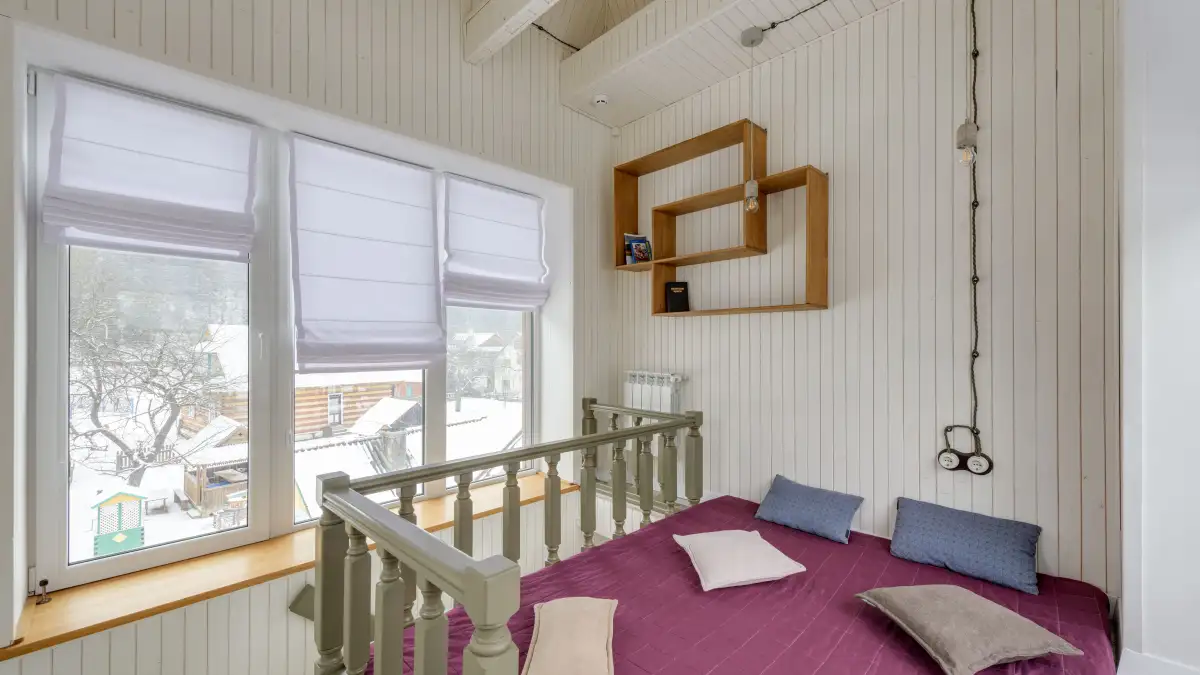
A Roman shade is one barrier. Not a stack of small ones. Whatever it accomplishes comes from three things: the weight of the face fabric, the interlining if there is one, and the lining.
An unlined cotton or linen Roman is a curtain that happens to fold up. It looks substantial and it insulates like a T-shirt. A blackout lining is doing a different job than people think it is: it is opaque, so it stops light, and it also stops air from moving through the panel, but it is not a thick insulator. A thermal lining usually means a heavier layer, sometimes interlined or foam-backed, and that is where a Roman shade starts to have a real effect. It gives the room air a surface that is warmer than the glass, which cuts the convective loop and cuts the radiant chill you feel from a cold window.
One barrier versus a stack of cells is the honest comparison. The flat panel slows the loop. The honeycomb interrupts it more thoroughly, per inch of depth at the window. That is the mechanical difference, and no amount of nice fabric closes it.
Summer reverses the argument in a way that matters for west-facing rooms. A blackout-lined Roman earns its keep in July by keeping sunlight from entering and heating the room's surfaces, which is a light problem, not a conduction problem. A cellular shade earns its keep by sitting between the hot glass and the cool room. Both help. They help with different physics, and a room can need one and not the other.
Comfort you can feel, savings you probably can't
The R-value numbers that circulate for window treatments are measured in a setup where the shade is sealed at the edges. Your window is not sealed at the edges. Anyone who has chased a real heating bill knows the honest version: savings shift with climate, with how good the window already is, and with how often the shade is actually down. In a house with decent double-pane windows, the difference between a lined Roman and a cellular shade is small enough that you should pick on looks and light and move on. In a house with old single panes and cold nights, the difference is noticeable in the room, not necessarily on the statement.
What you will notice is the surface. A cold interior surface pulls heat off your body by radiation, and your skin reads that as a draft even in perfectly still air. Warm the surface in front of the window by a few degrees and the room reads warmer at the same thermostat setting. That is where most of the value lives, and it is why a lined Roman shade can make a room feel better without doing much for the meter at all.
And a shade that is raised at five in the afternoon is a decoration. Most winter heat loss happens in the evening and overnight. Draw it at dusk, before the glass has had a chance to chill the room. In summer, on west-facing glass, drop it before the sun hits the window rather than after the room is already hot. The treatment is a machine you have to operate, and half of the complaints people have about window treatments are really complaints about their own timing.
What neither one will fix
If you put your hand near the frame and feel moving air around the sash, or through a sash pocket on an old double hung, no shade is going to solve that. The shade is downstream of the problem. Air sealing and a storm panel address the leak; the shade addresses the cold surface. Doing the shade first is like turning up the heat because a door is open.
So here is how I'd sort it, and it's the same test I run now before anyone in this house buys anything.
If the window is the coldest object in the room, if the shade stays down through the evening, and if the goal is a room that feels warmer at the same setting, the honeycomb structure is doing work that fabric cannot do, and the cell count and the edge fit are worth fussing over.
If the window is already reasonable, if you want light coming through something soft during the day, and if the appeal is the way a folded panel sits against the trim, a Roman shade with a proper lining is a fair choice, and you should make it knowing you're buying comfort and appearance more than insulation.
Either way, the answer for your window isn't on the box. It's at the sill, under your hand, at seven in the evening in January.