For a street-facing living room, cellular blinds are the more forgiving answer: a top-down/bottom-up cellular in a room-darkening or blackout fabric, mounted outside the window frame so the panel overlaps the trim on all four sides. Roman shades with a blackout liner can get you within a shade of the same darkness and look considerably better doing it, but only if you can mount them outside the frame and accept a thin line of light at the edges. When the window sits in a deep recess that forces an inside mount, the cellular wins by default.
I'm on the couch at 6:40 on a November evening with one lamp on, and there is a bright bar lying across the TV that isn't part of the show. Lean left, the bar slides. Lean right, it comes back. It's the neighbor's porch light coming through the gap at the edge of the shade, a gap I never noticed in daylight and can't unsee now.
So I put my shoes on and walked out to the sidewalk to look at my own house the way the street looks at it. Stand at the curb and the room reads as a glowing box with two bright vertical stripes down the sides and a soft line along the top. The middle of the window is fine. The middle was never the problem. Everything you don't want the street to see is leaving through the edges.
What the sidewalk test tells you
Do it once and you'll stop shopping by fabric sample. From the curb, count the leaks. There are four places light gets out: the two sides, the top, and the bottom. The bottom is usually the smallest because the sill or the bottom rail closes it up. The top is a narrow line you can fix with a valance or a headrail that returns to the wall. The sides are the ones that ruin the room, because light leaves at a shallow angle and travels sideways across your wall, your ceiling, and eventually the glossy surface of a television.
A finger's width of gap on each side is enough to read by from across the street. I measured mine out of curiosity and then wished I hadn't.
The number that actually matters isn't the window width. It's the overlap: how far the panel extends past the trim on each side and across the top. An inch and a half to two inches of overlap per side is the difference between a room that goes private at dusk and a room that glows in stripes until eleven. Most of the treatments people return are not bad products. They were specced to the opening instead of past it.
Mounting decides more than fabric does
Here's the part I got backwards at first. I thought I was choosing between a Roman and a cellular. I was really choosing between an inside mount and an outside mount, and that choice was made for me by the depth of the recess.
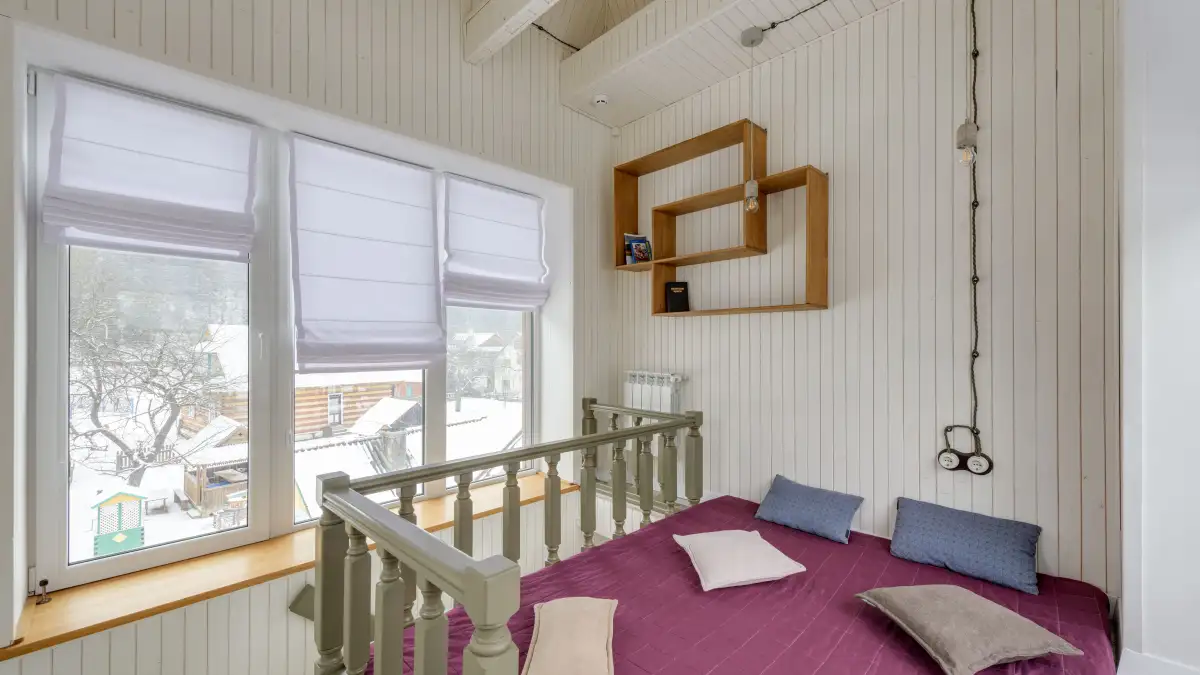
An outside mount hangs the headrail on the wall above the trim, and the panel floats free of the frame. That's what lets you build in overlap, and overlap is what closes the sides. A Roman shade mounted outside the frame, with a blackout liner and a bottom rail that lands against the sill or the wall below it, can go remarkably dark. Not perfectly dark. Dark enough that the neighbor's porch light stops painting your wall.
A deep recess changes the math. When the trim sits four or five inches back from the wall face, an inside mount is the only thing that looks intentional, and an inside mount means the fabric has to run within the opening. Any shade in that position leaves a sliver at the sides, because the panel has to travel without rubbing the frame. On a Roman, the fabric folds also bow slightly and the bottom rail swings a little when a draft pushes it, so the gap breathes. On a cellular, the panel is a flatter, stiffer unit and the gap stays put, but it's still there.
There's a second thing nobody mentions until you live with it. A Roman shade at the top of the window is a stack of folds three or four inches deep. On a tall window that's fine. On a shorter living room window it eats the top of the glass permanently, and it puts a shelf of fabric up there that catches light from the room. The cellular compresses down to almost nothing. On a small window that difference is not cosmetic.
Top-down is a privacy feature, not a darkness feature
This is the one that changed how I use the room.
With a standard bottom-up shade, opening it means raising the bottom rail. The lower half of the window is now bare, and the lower half is exactly what a person on the sidewalk sees. So you end up with a choice at 7 p.m.: sit in a dim room, or sit in a fishbowl.
Top-down lets you do the opposite. You hold the bottom rail at the sill and walk the top rail down instead, opening a band of glass at the top of the window. The bottom stays covered. Daytime glare off the upper sky gets handled, the room doesn't feel like a cave, and the street-level view into your living room stays shut.
Roman shades can be built to do this, but it isn't common and the hardware gets complicated, because the folds have to travel in both directions and the lift system has to manage that. Cellular shades are designed around it. If top-down operation is the thing you actually need, that need is quietly making the decision for you.
One honest caveat: top-down is not a blackout strategy. It's a coverage strategy. You're trading a strip of light at the top for privacy at eye level, and you should know that's the trade before you buy.
Fabric, liners, and the night test
Cellular shades come in tiers: light-filtering, room-darkening, and blackout. Roman shades come in whatever the fabric is, plus whether you paid for a liner. That's the whole rating system, and it's why comparing the two on paper goes nowhere.
What I do now, and what I'd tell anyone to do, is judge the fabric at night. Take the swatch home. Hold it against the window with the room lights on behind you, then walk outside and look back at it. Then take it into a dark closet and put a phone flashlight behind it. You're not judging color. You're judging glow. A heavy linen with a liner can read darker than a room-darkening cellular. A cotton print with no liner is a lampshade, whatever the label said.
Room-darkening is not blackout. It cuts the glow and keeps the shape of the window from reading as a lit rectangle, but if you're backlit in that room at night, silhouettes still happen. Blackout with unsealed edges is its own disappointment: a dark center framed by a bright outline, which can look worse than an even dim glow.
Liners earn their keep twice. A UV-blocking liner behind a Roman face or built into the cell does the same job either way, and if you have a rug or a sofa that's been fading on the sunny side, that's a reason to buy the liner regardless of which treatment you land on. I don't put numbers on it. I just know the couch by the window stopped changing color when the liner went in.
Where glare and heat actually get solved
Glare isn't brightness. It's contrast. A bright window against a dark room gives you a hot spot, and if that hot spot lands on a screen, that's your evening.
Cellular shades scatter light through the pleats, so the window becomes a soft panel. The hard-edged bright rectangle goes away, the view goes soft with it, and you get an even wash instead of a beam. Roman fabric is a single flat plane at the glass, so light passes more directly, and with a heavy face fabric you get a broad, pleasant wash, but you can still catch a bright reflection on a glossy TV at the wrong hour.
Neither one steers light. If your specific problem is a low winter sun at one angle that a quarter-inch slat tilt would solve in two seconds, you're looking at the wrong category. Cellular and Roman both soften; neither one aims.
On heat, the honeycomb does hold a layer of still air against the glass, and on a west or south window that buffer is real. But the size of the air pocket between the shade and the glass matters more than the shape of the cell, and a loose outside mount already creates one. This is a case where the honest answer is that the difference between the two is smaller than the difference between mounting either one well and mounting it badly.
What I'd do in the same room again
The order of decisions, not the products, is what I'd repeat. First: is there room to mount outside the frame? If yes, overlap the trim by an inch and a half to two inches per side and stop worrying about which treatment blocks more light. If no, accept that you're solving for the best inside mount and go cellular, because the flat panel and the small stack are less forgiving of a shallow recess than a Roman's folds are.
Second: do you need the bottom of the window covered while the top is open? If yes, top-down/bottom-up, and that's cellular.
Third: fabric, judged at night from the sidewalk.
Then, whatever you chose, plan on curtains. Panels on a rod wider than the window, overlapping the wall on both sides, with a return that pushes them back toward the wall, close side gaps better than any shade edge ever will. Let the shade handle the daytime glare and let the curtain handle the night. That combination has done more for my living room than any single treatment I've hung in it.
The mistake I'd avoid is the one I made first: picking a fabric in a showroom at noon, under lights that have nothing to do with your room at 7 p.m.