Rug Sizing for a King Bed: Under or Beside?
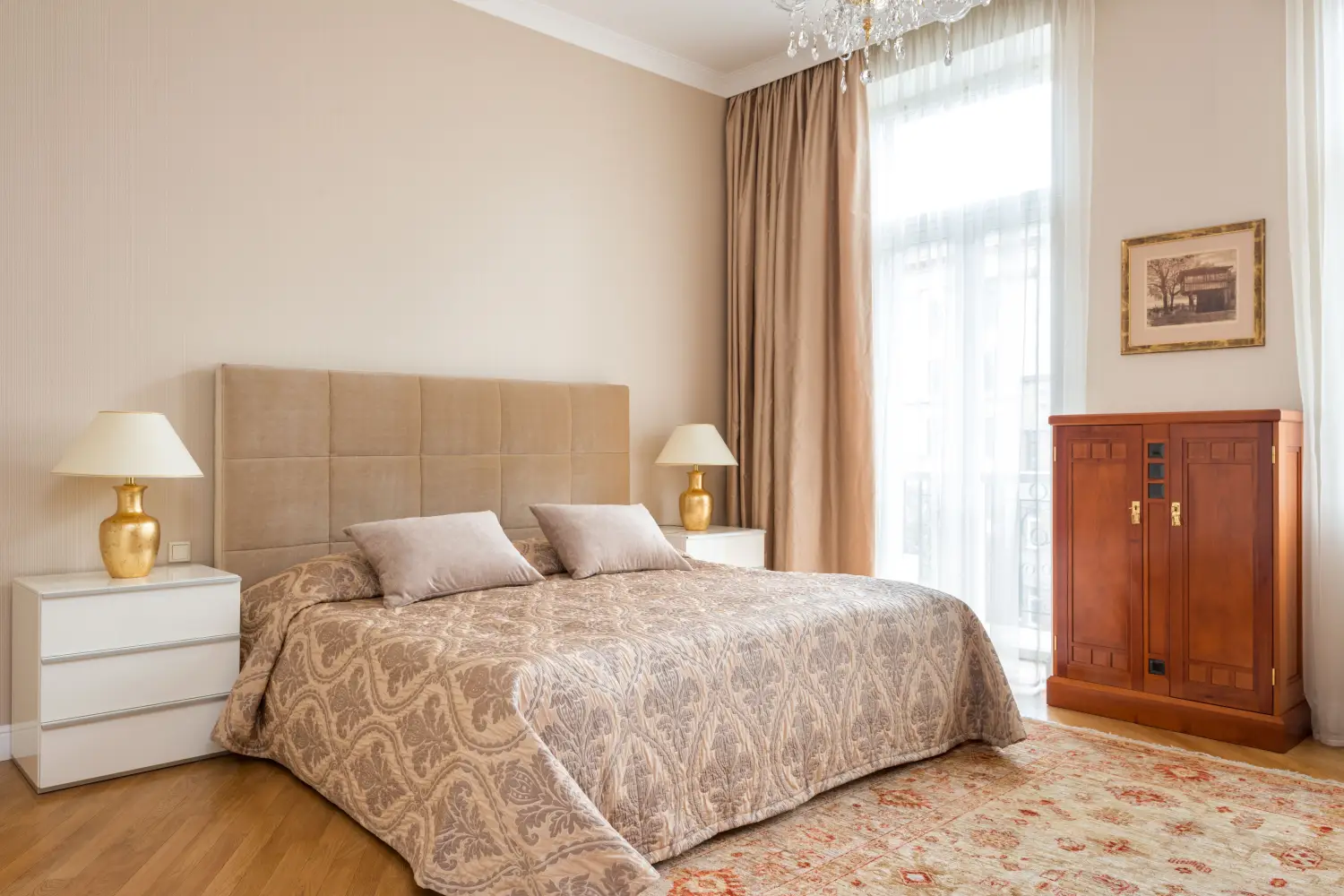
A king bed needs a rug that matches its generous footprint, and the choice between placing that rug all the way underneath, only partway beneath, or alongside the bed shapes how finished the room actually feels. This guide walks through the three practical approaches—full coverage where the rug reaches from the headboard wall past the foot, partial coverage that lets the rug sit under the bottom two-thirds of the bed, and side runners paired with a bench runner—and gives a clear sizing formula for each. You’ll also find a specific answer to the question of whether to put a runner under the bench at the foot, which gets its own dimension check inside the side-runner strategy.
The Bed, the Floor, and the Walkway: What Really Drives Rug Size
Three forces control how a rug fits a king bed: the combined width of the bed and nightstands, the walking paths that surround the furniture, and the visual weight you want the rug to carry in the room. Skip any one of these, and even a well-chosen rug can end up looking floating or cramped. Full coverage turns the rug into a room-sized anchor that feels intentional and settled. Partial coverage keeps more of the floor visible while still giving the bed a grounded look. Side runners solve narrow layouts where one big rectangle would pinch traffic lanes or cover built-in drawers. Each balance those three forces differently, which is why measuring carefully before shopping matters more than any style rule.
Full Coverage: The Rug Sits Under the Entire Bed and Nightstands
Full coverage means the rug starts at the headboard wall (or just under the headboard legs) and extends far enough that nightstands rest on it, and it runs well past the foot. This arrangement works best in larger master bedrooms where you want one unified floor plane that quiets the space.
Sizing formula for a king bed
- Width: Start with the bed width of 76 inches. Add at least 24 inches on each side for the nightstands and a walkable clearance—that totals 124 inches. A 10-foot-wide rug (120 inches) comes very close; the standard 10′×14′ rug gives you 48 inches of extra space beyond the sides, which lets each nightstand sit comfortably and leaves a generous margin.
- Length: Place the rug so it begins at the headboard wall and allow 24 to 36 inches beyond the foot of the 80-inch-long bed. That calls for 104 to 116 inches of length. A 14-foot rug (168 inches) handles this easily, and the extra overhang at the foot adds a layered, deliberate look.
When this is done well, you get the feel of wall-to-wall carpet under the bed, no bare floor peeking out beside the nightstands, and a consistent walking surface all the way around.
Partial Placement: The Rug Slides Under the Bottom Two-Thirds of the Bed
Here the rug starts roughly 12 to 18 inches forward from the headboard, so only the lower portion of the bed sits on it. It’s the most common budget-friendly option for a king bed because it uses standard 8′×10′ or 9′×12′ rugs and still defines a clear sleeping zone without eating up the whole floor.
Sizing formula for a king bed
- Width: Add 18 to 24 inches total to the bed width (about 9 to 12 inches exposed on each side). An 8-foot rug (96 inches) meets that minimum and leaves a sliver of bare floor beside the nightstands. Moving up to a 9-foot rug (108 inches) gives a more comfortable 16 inches per side.
- Length: Figure the distance from the rug’s starting point under the bed to the foot, then add 24 inches beyond. For a king, if the rug begins about 18 inches from the headboard, you have 80 minus 18, or 62 inches of bed coverage, plus 24 inches of overhang equals a minimum of 86 inches. An 8′×10′ rug clears that handily, and a 9′×12′ gives extra breathing room.
Done right, partial placement lets the nightstands sit on the bare floor, which simplifies cleaning and makes the room feel more open—but the bed still visually owns the rug.
Side Companions: Runners Beside the Bed and Under the Bench
Some bedrooms simply cannot accommodate a single large rectangle without blocking drawers or squeezing walkways. Splitting the rug into two long runners placed parallel to the bed, plus an optional bench runner, turns that constraint into a deliberate, layered look.
Runner sizing for a king bed
- Side runners: Use two runners, each 2.5 to 3 feet wide and 6 to 8 feet long, running along each side of the bed and leaving a clear middle aisle between them. A common combination is 2.5′×8′ runners spaced about 2 to 3 feet apart so the bed sits in the center—feet land on the runners when getting out of bed, but the middle floor stays open.
- Bench runner: When there is a bench at the foot, a single runner placed perpendicular to the bed’s centerline (running side to side in front of the bench) anchors it without needing a massive rug. A runner around 2′×5′ to 2.5′×7′ works proportionally for most king beds.
This approach fits well in narrow rooms, in apartments where door swings or closet access matter, or when the bed is flanked by built-in drawers that a large rug would cover.
Putting It All Together: One Room, Three Rug Choices
Imagine a 12-by-14-foot master bedroom with a king bed centered on the 12-foot wall, two nightstands, a dresser opposite, and a simple wooden bench at the foot. Here is how each strategy plays out.
- Full coverage calls for a 10′×14′ rug. The rug starts at the headboard wall, the nightstands sit squarely on it, and the extra length extends about 4 feet past the foot—the bench sits on the rug, too. The room feels finished, but the rug takes up most of the floor, leaving roughly 2 feet of bare floor at the sides when the bed is centered. That is still passable for walkways.
- Partial placement uses an 8′×10′ rug. The rug begins around 18 inches from the headboard, so the headboard area stays bare. The nightstands rest on the wood floor, and the rug runs past the foot by about 2.5 feet. The bench sits partly on the rug near the foot; the front half might hang off, which many people like as a layered look. The room feels more spacious.
- Side companions split the floor into three parts: two 2.5′×8′ runners run parallel to the bed, each starting near the edges of the nightstands and ending roughly a foot past the foot. A separate 2′×5′ runner sits perpendicular under the bench. The center aisle is completely open, which makes the room feel as wide as it actually is.
Common Stumbles: When Rug Sizing Goes Wrong
Buying a Rug That’s Too Small and Hoping It Will Look Bigger
Placing a 5′×8′ rug under a king bed looks like an afterthought. Even when the bed mostly covers it, the narrow strips peeking out at the sides read as accidental rather than designed. The fix is to think of the rug as a frame around the bed, not a hidden underlay.
Forgetting the Nightstand Footprint
With full coverage, if the rug is not wide enough to let the nightstands sit squarely on it, one nightstand ends up half on and half off the rug—a detail that feels off-balance every time someone walks through the room. The 24-inch side-clearance rule prevents that from happening.
Overlooking the Bench and Adding a Runner Too Late
Deciding on a full-coverage rug and then later adding a bench at the foot means the bench sits directly on top of the rug, which can feel heavy. Or a partial rug gets purchased, and then it becomes clear the bench needs its own surface. Planning for the bench from the start—even if it is not in the room yet—saves the trouble of hauling home a rug that ends up the wrong size.
Quick Reference: Rug Sizing Strategies for a King Bed
| Strategy | Goal | Key Action |
|---|---|---|
| Full coverage | Create a unified, anchored floor plane | Choose a rug at least 10′ wide and 12′ long; 10′×14′ is ideal |
| Partial underlay | Ground the bed while keeping floor visible | Use an 8′×10′ or 9′×12′ rug starting 12–18″ from the headboard |
| Side runners + bench runner | Maximize walkway space and add layered texture | Place two 2.5′×8′ runners parallel to the bed; add a 2′×5′ bench runner |
FAQ
What is the right size rug for a king bed when placing it entirely underneath?
A 10′×14′ rug is the safest choice. It gives at least 24 inches of rug on either side of the bed so nightstands rest fully on it, and it extends well past the foot. A 9′×12′ can work but leaves only about 16 inches per side—measure the nightstands first.
Can an 8′×10′ rug work under a king bed?
Yes, as a partial underlay. Place it so the rug starts about 12 to 18 inches from the headboard and runs past the foot. The nightstands will sit on the bare floor, and the rug still defines the sleeping zone without crowding a smaller room.
Should I put a runner under the bench at the foot of a king bed?
It often looks best. A runner around 2′×5′ to 2.5′×7′ placed perpendicular to the bed anchors the bench as its own piece. This works with any of the three strategies—even with a full-coverage rug, a runner can be layered on top for visual separation.
What if my bedroom is small—which strategy is best?
Side runners or a partial underlay usually fit better. Two slim runners beside the bed open up the floor visually, and a partial 8′×10′ rug keeps the bed anchored without cramping walkways.
Where to Start Measuring Today
Every rug-sizing decision for a king bed comes back to the same three-part logic: full coverage anchors a large room, partial underlay balances openness and grounding, and side runners rescue tight layouts. The practical first step—before settling on any rug—is to measure the bed width, add the side clearances your nightstands need, and then decide whether you want the rug to slide under the headboard area or stop short. That one measurement points directly to the strategy that fits your space best.

Clara Bennett
After five years of transforming my 1920s bungalow room by room, I’ve refinished floors, hung blinds in bay windows, and spent more time choosing light bulbs than I’d like to admit. I learned paint sheens by painting my kitchen ceiling three times, and I found out the hard way that a rug too small makes a room feel unfinished. I believe every home can be both functional and beautiful, no matter the budget.
Related posts
The Rug Sizing Rule Designers Use in Every Room
Stop guessing 5x8 vs 8x10. Use the designer framework: size your rug to your furniture grouping, not the room. Learn how to map, calculate, and test for a perfectly anchored room.
Dining Room Rug Size: Add 30 Inches to Table
Learn the exact 24-30 inch clearance rule for dining rugs. Use this simple math to prevent chair legs from catching and get the right size for any table shape.
4 Rug Mistakes That Make Your Room Feel Tiny
A too-small or floating rug shrinks any room. See the four worst rug placement errors ranked by how much space they steal, with before/after fixes you can try today.
Should Your Sofa's Front Legs Be on the Rug?
Yes, in most rooms the sofa's front legs belong on the rug. Get the exact width and depth formulas for front‑legs‑on, all‑legs‑on, and floating placements.