Dining Room Rug Size: Add 30 Inches to Table
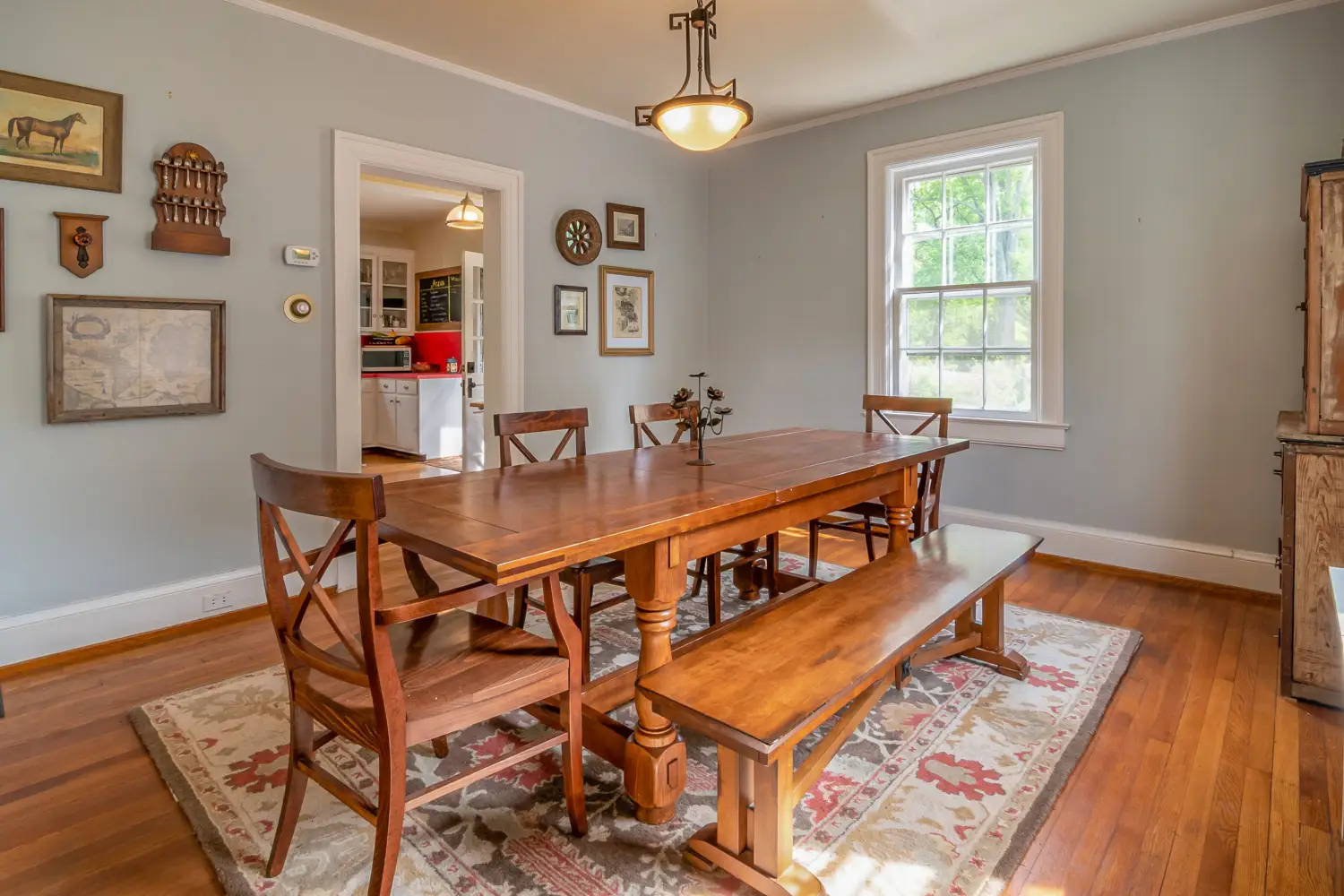
To size a rug under a dining table, add 24 to 30 inches of clearance beyond the table edge on all sides. That distance keeps chair legs from dropping off the rug when a person scoots back. For a 40-inch by 60-inch table, the minimum rug becomes 88 by 108 inches—an 8-by-10-foot rug is the closest standard size.
The Result: 24–30 Inches of Clear Floor Around Every Seat
A correctly sized rug stays under every chair, even when pulled out far. There is no bump or snag as chair legs move across the rug’s woven surface. The rug sits centered under the table, creating a defined dining area with a consistent border of bare floor between the rug and the walls.
How to Calculate Your Rug Size Using the 30-Inch Rule
- Measure your table’s length and width at the widest points (including any apron or protruding legs).
- Decide whether you’ll use 24 inches (tighter fit) or 30 inches (comfortable clearance) of extra space per side.
- Add twice the clearance to each dimension: length + 60 inches, width + 60 inches (or 48 inches if using 24").
- For round tables, add twice the clearance to the diameter.
- Confirm that the calculated rug size won’t block doorways or furniture in your actual room dimensions.
- When shopping, round the calculated dimensions up to the nearest standard rug size.
Checklist Steps Explained
Measure Your Table’s Exact Length and Width
Run a tape measure across the table’s widest points—the top edge itself or any part of the base that extends outward. Nothing should be assumed from a label. This takes less than two minutes. Skipping the measurement and trusting listed dimensions is the most common error, especially when the table includes leaves or has a base wider than the top.
Choose Your Clearance: 24 Inches or 30 Inches
At 24 inches, the back legs of a pulled-out chair will usually land right on the rug’s edge. At 30 inches, there is a margin of safety. A narrower clearance—such as 18 inches—might seem sufficient until someone pushes back quickly and the legs drop off the rug, creating a sudden trip hazard. If the room dimensions allow, 30 inches is the safer choice.
Add the Clearance to Both Sides: Simple Math for Rectangular Tables
Take the table’s length and width. Add the clearance twice—once for the left side and once for the right (or front and back). For a 40-by-60-inch table with 30 inches of clearance: 40 + 60 = 100 inches wide, 60 + 60 = 120 inches long. The mistake to avoid is adding the clearance only once, producing a rug that only extends beyond the table on two sides instead of all four.
Adjust for Round and Oval Tables
For a round table, add twice the clearance to the diameter. A 48-inch round table with 30 inches of clearance requires a 108-inch-diameter rug (a 9-foot round). For oval tables, treat the longest length and widest width as the rectangular dimensions and apply the same doubling rule. An error point: measuring only the tabletop surface, not a wider apron or decorative base that may catch chair legs if not covered.
Check the Rug Size Against Your Actual Room
Measure the available floor space in the dining area. Leave 18 to 24 inches of bare floor between the rug’s edge and any wall or large piece of furniture. If the calculated rug size will obstruct a doorway or narrow a walkway, reduce to the next standard size—while keeping the clearance rule as close as possible. The frequent oversight is buying a rug based solely on table dimensions, then discovering after delivery that the rug makes the room feel cramped.
Choose the Closest Standard Rug Size
Rugs are sold in set sizes: 5x8, 6x9, 8x10, 9x12, and up. Round up, not down. An oversized rug can be positioned slightly off-center under a buffet if needed, but an undersized rug will always cause chair legs to catch. Custom sizing is rarely necessary; standard rugs cover almost all dining tables when the clearance rule is applied correctly.
Final Verification: Pull One Chair Back Before You Buy
- Place a chair at the table, pull it out as far as it would go when someone sits down.
- Note where the rear chair legs touch the rug.
- Measure the distance from the table edge to those legs; it should be at least 24 inches with a little extra to spare.
- Repeat the test on both sides of the table.
Frequently Asked Questions
What if my dining table has extension leaves?
Measure with all leaves extended. The rug must fit the largest configuration. If it doesn’t, you’ll have to constantly shift the rug when the table grows, which defeats the purpose of a well-anchored dining setup.
Is 24 inches really enough, or should I always use 30 inches?
Twenty-four inches is adequate for compact spaces. But chairs with deep seats or armrests can push the back legs beyond a 24-inch clearance, causing them to drop off the rug. Where room dimensions permit, 30 inches provides a reliable margin.
How do I calculate rug size for a round table?
Double your chosen clearance and add it to the diameter. A 48-inch round table with a 30-inch clearance needs a 108-inch-diameter rug, typically stocked as a 9-foot round.
Can I place a rectangular rug under a round table?
Yes, provided the shortest side of the rectangle delivers the full clearance beyond the table edge. A round rug looks more symmetrical underneath a round table, but a rectangle works just as well if sized correctly.
What if my rug only comes in a standard size slightly smaller than my calculation?
Choose the next standard size up. A rug larger than needed rarely creates problems—you can shift the table to center it. A rug that’s too small will always cause chair legs to catch.
The Payoff: A Dining Area That Works Without Friction
With the right rug size, chair legs move smoothly and the dining zone stays visually anchored. The fastest way to repeat this result: measure the table once, add 60 inches to both dimensions, and round up to the nearest standard rug size.

Clara Bennett
After five years of transforming my 1920s bungalow room by room, I’ve refinished floors, hung blinds in bay windows, and spent more time choosing light bulbs than I’d like to admit. I learned paint sheens by painting my kitchen ceiling three times, and I found out the hard way that a rug too small makes a room feel unfinished. I believe every home can be both functional and beautiful, no matter the budget.
Related posts
The Rug Sizing Rule Designers Use in Every Room
Stop guessing 5x8 vs 8x10. Use the designer framework: size your rug to your furniture grouping, not the room. Learn how to map, calculate, and test for a perfectly anchored room.
4 Rug Mistakes That Make Your Room Feel Tiny
A too-small or floating rug shrinks any room. See the four worst rug placement errors ranked by how much space they steal, with before/after fixes you can try today.
Should Your Sofa's Front Legs Be on the Rug?
Yes, in most rooms the sofa's front legs belong on the rug. Get the exact width and depth formulas for front‑legs‑on, all‑legs‑on, and floating placements.
Rug Sizing for a King Bed: Under or Beside?
Compare three rug placement strategies for a king bed—full coverage, partial underlay, and side runners—plus sizing formulas and a runner-under-bench check. Get the right fit.