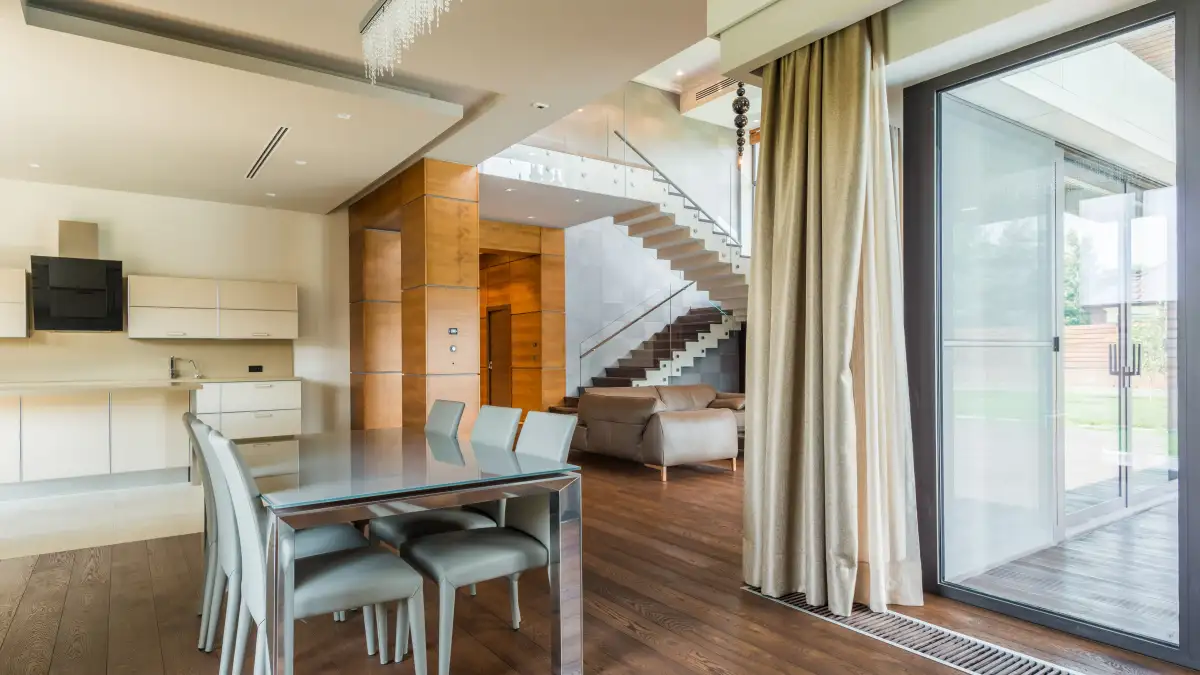
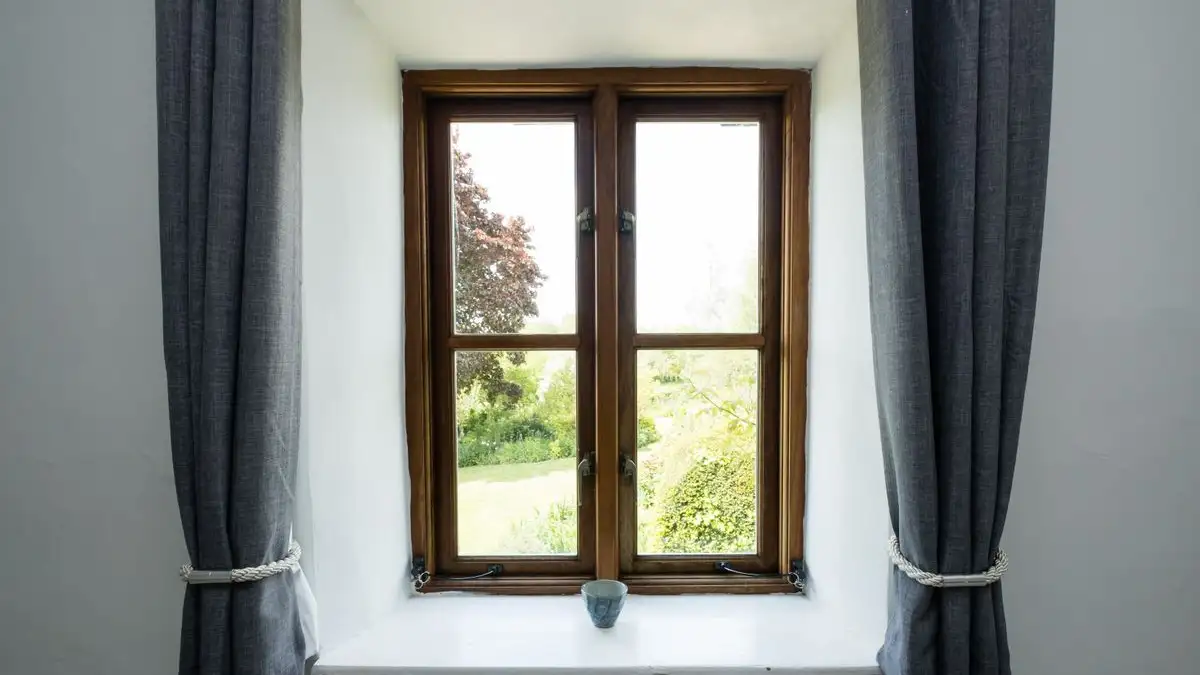
An inside-mount panel is measured from the top of the window recess — or from the underside of the bracket sitting inside it — down to the sill, and it stops there, because fabric cannot pass through a sill. An outside-mount panel is measured from a rod set on the wall or trim face above the opening, and it runs as far past the sill as the room allows. Same window, same glass, same room, and the two numbers can sit a foot apart. Which one belongs on the order form was decided before anyone pulled the tape.
I keep a step stool in the back of the car, and here is what happens on it. You hook the tape over the top edge of the recess, drag the blade up until the hook catches, and read the number where the sill crosses the tape. Sixty-two. You write sixty-two on the back of a receipt, fold it into your pocket, climb down, and order sixty-two inches of curtain.
The panels arrive and hang three inches short of the sill with a hard stripe of daylight underneath. Nothing was mismeasured. Sixty-two inches was the height of the recess. A curtain doesn't hang from the top of a recess, though. It hangs from a rod, the rod hangs from a bracket, and the bracket holds that rod an inch or so below the top edge so the fabric has somewhere to go. Then the hem has to clear the sill, or the panel drags across it every time the heat kicks on.
The number was honest. It was the answer to a question nobody asked.
Two starting lines, one opening
An inside mount puts the rod inside the recess, so the tape's starting line is either the ceiling of the recess or, once you know your bracket, the underside of the rod that bracket carries. Those are not the same line, and the second one is the one that matters. Fabric falls from the rod, not from the architecture.
An outside mount puts the rod on the wall face or the trim face, above the opening and clear of the recess entirely. Now the starting line is the underside of a rod you chose to put there, and you chose how high. Two inches above the casing, four inches, a hand's width — each of those raises the top of the panel by exactly that much, and drags the bottom of the panel down with it if you're holding the hem in place.
That's the whole mechanism. One window, two legitimate starting lines, two completely different length figures. It isn't a measuring error and it isn't a matter of taste. It's that the recess and the wall are different objects, and the tape begins wherever the rod actually sits.
What the sill does to the number
On an inside mount, the sill is a hard stop. The panel can't hang through it, so the fabric ends above it — usually a half inch to an inch of clearance, more if you want the panel to clear the sill cleanly when the window is open. Everything below that line is not curtain. It's sill, apron, wall, baseboard, floor.
On an outside mount, the sill stops mattering. The rod sits out on the wall face, the panel hangs in a plane in front of the trim, and the sill is behind the fabric instead of underneath it. The hem can land at the floor, just below the apron, at the top of a radiator, wherever the design calls for.
Sit with that for a second, because it explains a lot of confusing quotes. In an older house with a deep stool and a chunky apron, an inside-mount panel can lose most of a foot right there — the fabric stops at the sill while an outside-mounted panel on the same window runs to the floor. If you measured the recess first and then went shopping for a floor-length look, you're ordering the wrong number. The room didn't change. The stopping point did.
Depth and width decide the mount before length ever does
Here's the part that gets skipped: on many windows, you don't get to choose the mount at all. The recess decides for you.
Start with depth. Measure it at the shallowest point, and the shallowest point is rarely in the middle — it's usually right where a crank handle sticks out. A slim rod with flat panels needs somewhere around an inch and a half of usable depth. Add a return to the wall, add a real stack of fabric, and you're closer to three. If the depth isn't there, an inside mount is not a compromise. It's not an option.
Then width. An inside-mount panel is cut to the recess width minus a small amount of clearance, usually a quarter to a half inch total across the whole opening. Get greedy and cut it narrower, and you'll see two vertical slivers of daylight down the sides of the panel every evening — light doesn't care that your measurements were tidy. An outside-mount panel, by contrast, is sized as the opening plus several inches of overlap on each side, plus the return back to the wall. That overlap is what kills the light leak, and it's also why the outside-mount panel looks wider than the window it covers.
The windows that simply refuse an inside mount tend to be the same few culprits: a casement crank that swings into the recess, a storm-window frame sitting proud of the casing, a deep decorative casing that eats the depth, a sash that swings outward. I've stood at windows where the depth at the center was generous and the depth at the left jamb was under an inch because of a crank. Measure the tight spot or don't bother measuring.
The three numbers I write down before I write a length
Recess depth, at the shallowest point. Recess width, checked at the top, the middle, and the sill — old openings are not rectangles. The outer face of the casing, edge to edge, because that's the line an outside mount has to clear and the number the panel width gets built from.
Only after those three are on the card do I write a length, and by then the length means something specific. It's either a recess drop, capped by the sill, or it's a wall drop, from a rod I placed, running to a hem I chose.
A tape measure is honest. It answers exactly the question you ask it. Ask it how tall this recess is, and you'll get the inside number. Ask it how far it is from a point on the wall face down to the floor, and you'll get the outside number. Both are true. Neither substitutes for the other, and the mount type is what tells you which question you're allowed to ask.
If you take one habit away from all this: decide the mount, then measure. Not the other way around.