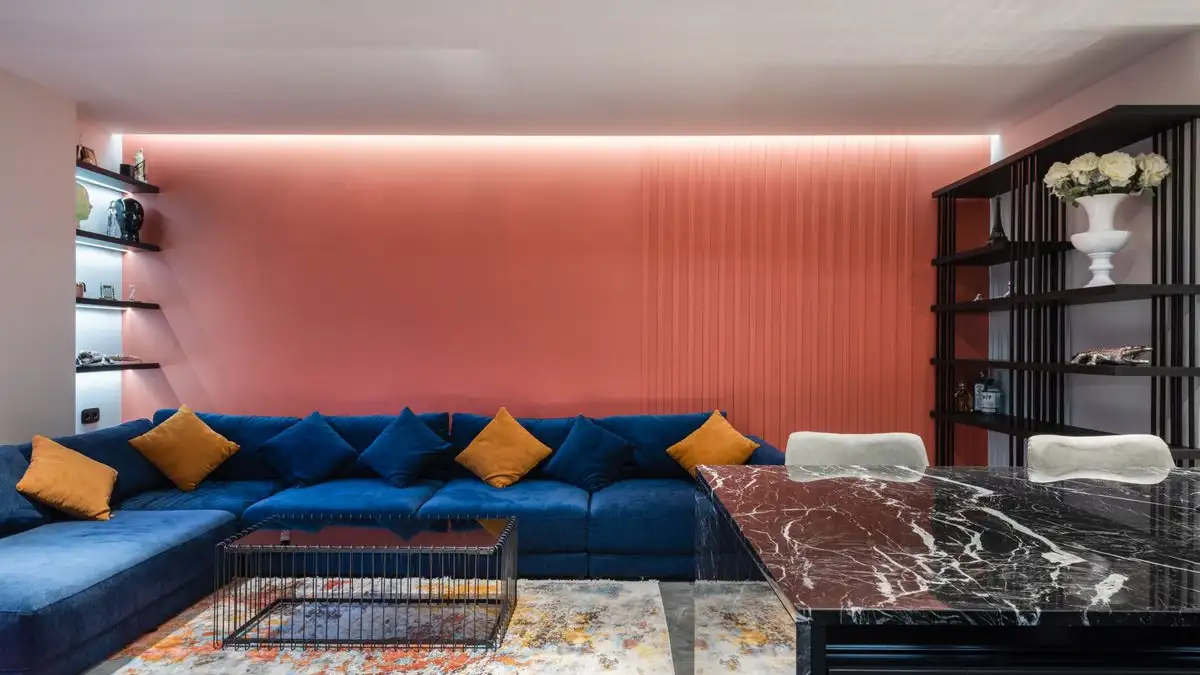
A plain room gets a focal point from contrast, not from an object. Find the wall your eye already goes to when you walk in, give that one plane visibly more visual weight than everything around it, and keep the rest of the room quiet enough that the weight registers. That single move does the job a fireplace would have done, and it does not require construction, a kit, or a new piece of furniture.
I want you to do something before you buy a sample pot or a roll of paper. Stand in the doorway of the room at four in the afternoon, when the light is flat and honest, and look once. Not a survey. One look, then say out loud where your eye landed. Most people I've walked through this with say "the window," or "the TV," or "nowhere, it's just a box." That answer is your whole plan. If your eye already lands somewhere, you don't need to invent a focal point, you need to reinforce the one you have. If it lands nowhere, you get to choose which plane carries it, and you should choose deliberately instead of painting the wall that happens to be the emptiest.
Two walls usually qualify. The one you face walking in, and the one opposite the main seating. Sit down in the actual chair, the one you actually use, and check again, because the doorway view and the seated view are not the same view, and the seated one wins. You live in this room sitting down. If the wall you loved from the doorway is behind your shoulder while you watch TV, it is not your focal wall no matter how good the paint chip looked.
Three levers do all the work here: contrast, repetition, and empty space. Everything below is one of those three.
Start with where your eye already goes
The fireplace normally wins because it's an object with weight sitting on a plane, and the room organizes itself around it. Take it away and the weight has to come from the plane itself. That's why an accent wall is the right tool and why it fails so often: people pick the wall by convenience, not by sightline, and then wonder why the room still feels like a box with one odd wall in it.
When I walk into a room to judge this, I'm not looking at the wall. I'm looking at the path my eye takes. Window, corner, sofa, back to the door. If the eye has a natural resting place, paint that. If it bounces around, pick the wall opposite the seating and give it the weight, and the eye will settle there because there's finally something heavier to land on.
A dark wall can read as a hole
Here's where contrast tricks people. High contrast adds visual weight, yes, but weight only exists relative to something lighter. In a bright room with white trim and pale floors, one deep wall reads as an anchor. In a dim room, a north-facing room, or a room with dark floors and heavy furniture, the same wall can read as an absence. I've watched a deep green wall go fully black at eight in the evening and turn the room into a cave with a missing side. Nobody calls that a focal point. They call it a mistake, and they paint over it.
My test is unglamorous. Tape the chip or the paper sample to the wall, turn on the lamps you actually use at night, and stand back. If the sample merges into the shadow and you can't tell where the wall ends and the corner begins, you've got a void. You either need a lighter, warmer tone, or you need light on that wall, and I'll get to that.
Pattern: subject or texture
Scale decides whether wallpaper is the focal point or the backdrop, and this is the part that gets bought wrong most often.
If you can see the repeat from the doorway, meaning your eye catches the rhythm of the motif repeating, the pattern reads as texture. It's beautiful, it's rich, but it's a surface, not a subject. If you see one motif at a time, roughly the size of your hand or larger, the pattern reads as a shape, and a shape can hold a room.
So: large-scale pattern for the focal wall. Small-scale pattern for a wall you want to feel like fabric, which is a different and equally good goal, just not the one this article is about. And a small print on one wall of a big plain room will read as a tint, not a focal point, and you'll be disappointed at how little it did.
Weight without color
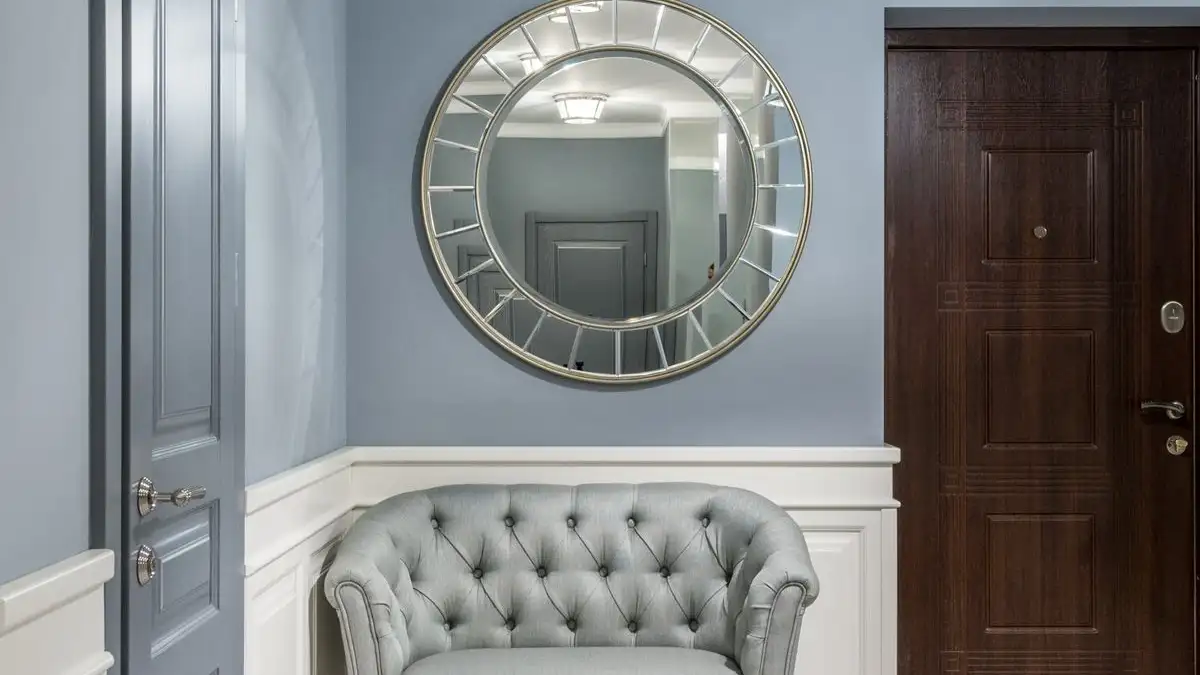
Some rooms can't take contrast. A small room, a low ceiling, a room with no direct light. For those, weight comes from relief instead of tone. Board and batten, picture frame molding, slat panels, a plaster finish with real hand in it. These give the wall shadow lines, and shadow lines hold the eye almost as hard as a dark color does, without shrinking the room.
The tradeoff is honest: you get less punch and more quiet. In a small room, quiet is usually the better trade. I'd rather have a textured wall that reads as intentional in a tight room than a dramatic dark wall that makes the room feel like a hallway.
One plane, not two
A focal wall needs one uninterrupted plane. The moment a door, a large TV, or an awkward cutout splits the wall, your eye reads two smaller walls and the weight scatters. This is the most common reason a technically correct accent wall still doesn't work.
You have three moves. Choose a different wall that isn't broken. Center the composition on the largest unbroken run and let the door be part of the architecture rather than fighting it. Or accept that the wall isn't the focal point and use a piece of furniture with mass, which is a different article but an honest answer.
And keep the wall mostly empty. This is the negative-space lever and people resist it. If you hang nine frames on your accent wall, you've made nine small focal points and no big one. The empty stretch of wall is what makes the rest of it read.
One last piece of the same lever: repetition binds the wall to the room. Take the wall's color and echo it in two low places, a pillow, a lampshade, a bowl on the table, so the eye can travel from the wall down into the furniture and back. Without that, a strong accent wall floats. Two echoes is enough. Three starts to look like a theme.
Then turn the lamps on
Design the room twice, once in daylight and once at night, because the wall you built at four in the afternoon goes flat at nine. Contrast disappears when there's no light to make it. Texture survives better than color, which is another argument for relief, but you can bring a colored wall back with light.
A wall wash from above or a small picture light aimed along the surface pulls the wall forward after dark. Grazing light from close to the wall exaggerates every imperfection in the drywall and every bit of texture you paid for, both at once, so aim it, don't just hang it and hope. This is the step almost everyone skips, and it's the difference between a room that has a focal point all day and one that has a focal point until dinner.
If you get to the end of this and can stand in the doorway and say where your eye lands in two seconds, you're done. If you can't, you don't need more decorating. You need one plane with more weight and less on it.