No Natural Focal Point? Here's How to Build One That Looks Right
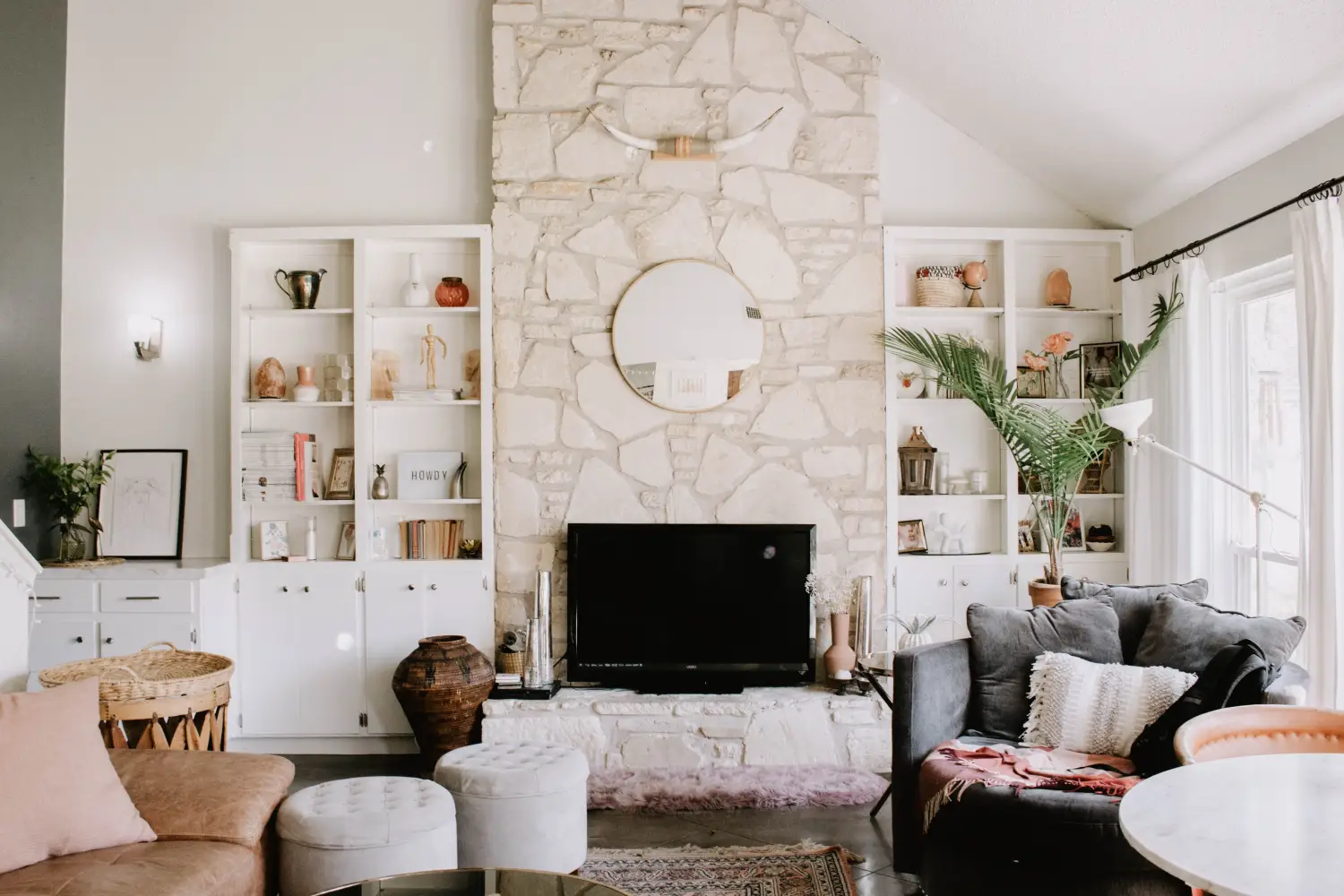
A blank room without a fireplace or bay window leaves the eye restless. That doesn’t mean you’re stuck with a boring wall. You can assemble a focal point from scratch using nothing more than smart proportion, a statement art piece, or an accent wall—and it will look like it always belonged there.
The 5-Move Game Plan for a Focal Point That Doesn’t Exist Yet
- Decide on an anchor: oversized art, a whole accent wall, or a furniture grouping that seizes the wall.
- Scale that anchor to at least two-thirds the width of the wall or the furniture below it.
- Arrange the remaining objects into a triangle—the eye naturally follows a peak and a base.
- Add an accent wall only if the anchor needs depth, and only if the wall’s color steps back, not forward.
- Cut every element that tries to steal attention until the focal point is the first thing you register when you walk in.
Step 1: Pick the Anchor That Will Do the Heavy Lifting
The wall behind a sofa, bed, or the longest stretch of empty wall in an open plan is your canvas. The anchor itself can be a large artwork, a console-and-shelves grouping, or an accent wall. If a TV must live there, fine—just don’t let it call the shots. Surround it with enough visual weight that the composition still reads as deliberate when the screen is dark.
Step 2: Scale the Anchor So It Feels Like It Belongs, Not Like a Sticker
Art that’s too small is the single most common mistake. If the art hangs above an 84-inch sofa, its framed width should land between 56 and 72 inches—roughly 55–75% of the sofa’s width. For a furniture grouping, the central piece must account for at least half the visual mass. An accent wall needs the full wall; a painted rectangle or half-height panel looks accidental, not intentional. Getting scale right prevents the room from reading as under-furnished.
Step 3: Turn the Setup Into a Visual Triangle (Without Fussing Over Symmetry)
Once the anchor is locked in, form a pyramid. Under a large piece of art, place a console of similar width, then drop a lower object on each side—a floor lamp to the left, a plant or a chair to the right. Heights step down from the center. In a furniture grouping, put the tallest piece in the middle and shorter pieces outward. Offset by a few inches; dead symmetry looks staged, not lived-in.
Step 4: Use an Accent Wall for Depth, Not Competition
If the anchor still feels slight, paint or paper the entire wall behind it. A vibrant art piece needs a muted backdrop; monochrome art can handle a textured wall—shiplap, board and batten, tonal wallpaper. When the accent wall is the star (no huge artwork), stick to a large-scale pattern that doesn’t scream and pair it with low-profile furniture. Many rooms skip this step entirely because a well-scaled anchor doesn’t need it.
Step 5: Edit the Room So Nothing Else Shouts
Stand at the main door. If a bright rug or an overly tall lamp with a loud shade steals the first glance, tone it down or move it. Strip the focal wall of tiny decor—leave just the anchor and two or three supporting pieces. Check the wall opposite the focal point; if it’s equally busy, the room splits in half visually. The edit is where good turns into intentional.
Did You Get It Right? Checkpoints for Each Move
- After scaling: from the farthest corner, the art doesn’t read as a stamp.
- After grouping: across the room, the arrangement reads as a stable triangle with a clear high point.
- After accent wall (if used): squint—the darkest or brightest spot should still be the anchor, not the wall.
- After final editing: first glance lands on the focal point in under a second, then flows elsewhere.
When It Still Looks Wrong: The Two Fastest Fixes
- The composition feels heavy or messy. Pull the weakest side object. Three pieces—anchor, a tall side, a low side—beat five cluttered ones every time.
- The accent wall is fighting the art. Repaint the wall a tonal value of the art’s background color or a shade darker. The wall is a backdrop, period.
- The focal point floats disconnected. Ground it with a rug that touches the console’s legs and the front legs of nearby seating. That physical link pulls the zone together.
Frequently Asked Questions
Can a TV be a focal point?
A blank black screen isn’t architecturally strong. Embed it in a gallery wall or place it over a long console flanked by bookshelves or large plants. The off-screen composition carries the weight.
What if the room is very small?
Scale proportionally. A 48-inch sofa can handle art 30–36 inches wide. Or swap the art for a floor-to-ceiling mirror—it becomes an instant focal point and makes the room feel larger.
Is it ever okay to have two focal points?
Only if one dominates. A fireplace can lead, and a big window can play a secondary role, but if both demand equal attention, the room feels insecure.
How do I create an accent wall in a rental without paint?
Removable wallpaper, a large leaning mirror, or a tall styled bookshelf all do the job. A well-dressed bookshelf anchors a wall just as strongly as art.
Do I always need an accent wall?
No. A correctly scaled anchor on a uniform neutral wall works. Accent walls help only when the anchor needs extra depth or the room’s architecture is flat.
Now That the Room Has a Center
With the focal point locked in, the next move is lighting that reinforces it—try a directional ceiling spot on the art or a pair of sconces that bracket the composition and add dimension.

Clara Bennett
After five years of transforming my 1920s bungalow room by room, I’ve refinished floors, hung blinds in bay windows, and spent more time choosing light bulbs than I’d like to admit. I learned paint sheens by painting my kitchen ceiling three times, and I found out the hard way that a rug too small makes a room feel unfinished. I believe every home can be both functional and beautiful, no matter the budget.
Related posts

The Design Rule That Decides Where Your Eyes Go First
Discover how the focal-point principle rooted in cognitive psychology simplifies room navigation and cuts decision overwhelm for new homeowners planning whole interiors.
The Focal Point Mistake That Makes Your Room Feel Unstable
That uneasy feeling often comes from two focal points fighting for attention. Learn how to demote one into an accent and restore visual calm—fast.
3 Size Rules Every Focal Point Must Follow to Look Right
Nail focal point scale with three measured ratios. Learn how 30-40% wall width, 50-75% height, and depth limits prevent visual discomfort.