The chair should take the biggest slice of a home office budget — 30 to 40 percent of whatever total you set — with roughly 15 to 25 percent for the desk, 10 to 15 percent for lighting, 10 to 15 percent for storage, and 5 to 10 percent for window treatments. Those percentages only work in the order they get spent, though, and the order is set by how hard each decision is to undo: layout first, then seating, then lighting, then storage and the finishing layers. Layout costs nothing and governs everything after it, which is why it comes first even though it never shows up as a line item.
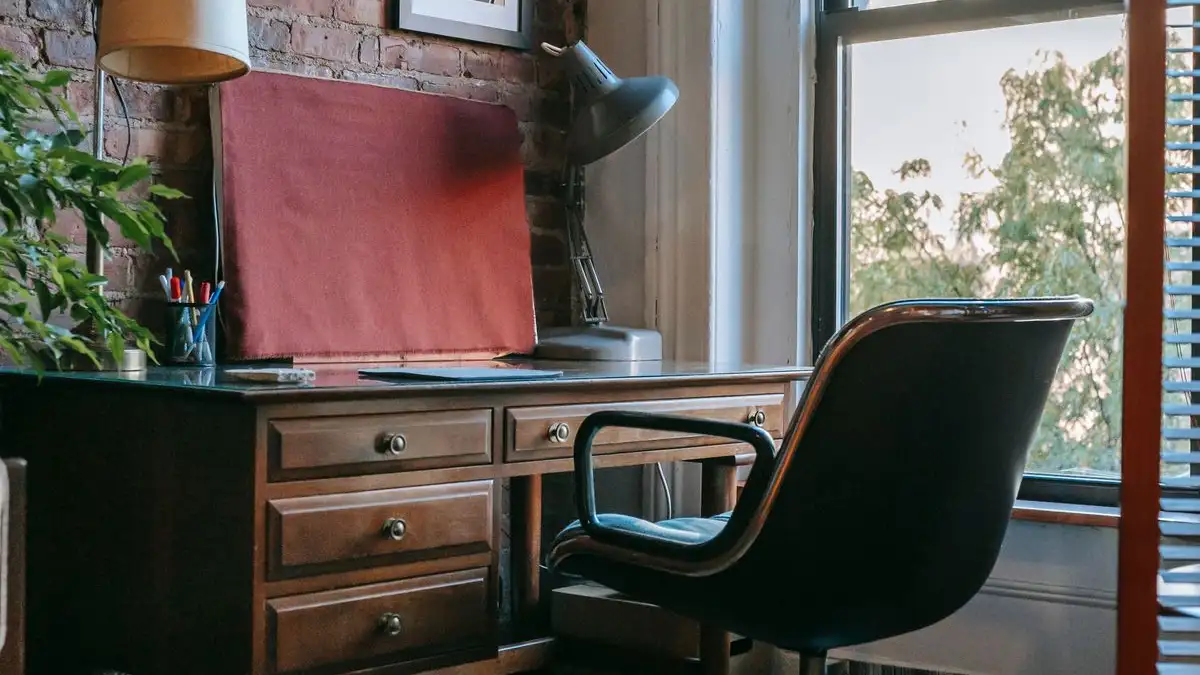
I tape the room before I shop. Blue painter's tape on the carpet: a rectangle for the desk footprint, a smaller square where the chair sits, and a longer rectangle behind it for where the chair lands when it rolls back. Then I do the boring part — open and close the door, watch where the swing lands, walk the path from the doorway to the seat with my arms full, the way I actually come into a room carrying coffee and a laptop bag. If the door clips the chair's roll zone, or the walk path crosses it, no purchase fixes that. The desk gets narrower, or the room gets rearranged.
That's the whole argument for putting layout ahead of money. Room dimensions, window location, door swing, outlet placement — those are fixed. They set a box, and every later decision has to fit inside it.
The window deserves the next ten minutes, because it decides more of the budget than people expect. Sit where the desk would go at the hour you actually work. Window in front of you means the view and, depending on which direction it faces, sun in your eyes by mid-afternoon plus your own reflection on the screen. Turned perpendicular to the window, you get daylight spilling across your work surface and a screen that stays readable. Same room, same furniture budget, two completely different outcomes, and the only difference is which wall the desk went on.
What the split looks like written down
| Category | Share of total | Why it sits there |
|---|---|---|
| Seating | 30-40% | Hardest to retrofit; wrong seat depth is wrong every hour |
| Desk | 15-25% | Sized by the layout, not by taste |
| Lighting | 10-15% | Depends on desk position and screen placement |
| Storage | 10-15% | Sized by under-desk clearance and what you actually keep |
| Window treatments | 5-10% | Lowest priority unless glare or privacy is a real problem |
Run it against a hypothetical total — say $1,500, just to make the percentages visible. Seating gets roughly $450 to $600, the desk $225 to $375, lighting $150 to $225, storage $150 to $225, and window treatments $75 to $150. The bands don't all land at the top of their ranges at once, so don't add the ceilings together and expect the math to close. If the chair eats 40 percent, something downstream gets less.
The chair earns the largest share for a specific reason
A chair is the one piece in the room that can't be quietly absorbed. A lamp that throws the wrong light gets moved. A shelf that's ten inches too wide goes on a different wall. A chair that's wrong in the seat depth, or whose armrests sit above the desk edge so the seat won't tuck under, is wrong every single hour you sit in it, and replacing it means re-solving the whole arrangement.
So I check the things that can't be adjusted later. Seat depth should let you sit back against the backrest with about a fist's worth of space behind your knees. Armrests have to drop low enough to disappear under the desktop, or you'll end up sitting forward all day. The height range matters more than the height you set it to — a cylinder with a short range is a cylinder that fits one body. And the chair has to roll on whatever is actually under it: casters that glide across a low-pile carpet will chew a hardwood floor, which is why soft rollerblade-style wheels and a chair mat exist and why that decision belongs to the flooring, not the chair catalog.
If you already own a chair you genuinely sit in for six hours without thinking about it, move that 30 to 40 percent to the desk. The split is a starting position, not a rule.
Lighting comes next, because it depends on where the desk landed
Lighting is second in the order not because it costs more than storage, but because you can't finalize it until the desk position is settled. Three jobs, three answers: general light for the room, a task light for the paper or keyboard in front of you, and enough control to kill the reflection on the screen.
A task lamp placed at your dominant hand's side throws a shadow of your own hand across the page. Placed on the opposite side, or clamped behind the monitor aimed down and in, it doesn't. That's a placement problem, and placement problems are cheap to solve if you decide them before you buy. A ceiling fixture alone rarely does the job in a room with one window, because it puts light on top of your head and not on the work.
Keep the color temperature consistent across lamps. Mixing a cool white overhead with a warm bulb at the desk makes the whole room look off, and it will make whatever paint you chose look off with it — a warm white wall reads yellow under one fixture and gray under another. If you want the lighting to do double duty in a room you also use on camera, point it at the wall behind you rather than at you.
And pay attention to the wall finish while you're at it. A satin or semi-gloss wall facing a bright window bounces a visible sheet of glare toward the screen. That's a paint sheen decision, not a lighting one, and it costs nothing to get right at the start.
Storage is where the earliest money is most often wasted
Storage sits in the middle of the budget because it's the category most likely to be bought in the wrong order. A tall bookcase bought before the desk is placed ends up on the only wall that was left, and then the desk lamp has no outlet nearby.
Measure the under-desk clearance first — the gap between the floor and the underside of the work surface — because that number decides whether a mobile pedestal fits, and whether it fits when the chair is also pushed in. Then decide how much paper you actually keep. Most people plan storage around the volume of paper they had a decade ago and end up with empty drawers and a filing cabinet that eats the corner of a small room.
Small rooms do better with vertical storage above the desk and one slim drawer unit than with a floor-standing cabinet. If you rent and can't drill into the wall, tall freestanding shelving with a wall-anchor strap is the honest answer, and it should be anchored regardless.
Window treatments can wait — with two exceptions
Window treatments sit at the bottom of the split because they're the easiest line item to add in six months. A tension rod and a temporary paper shade will get you through a season if the window isn't causing a real problem.
Two situations move them up the list. If the room is at street level or faces a neighbor, privacy stops being decorative. And if the sun hits your screen at the hour you work, glare isn't a comfort issue, it's a daily tax — you'll tilt the monitor, squint, and lose the morning. In those cases, pull the money forward and take it out of storage instead.
The practical version: a solar or light-filtering shade that stops at the sill keeps the daylight and cuts the direct hit, and it's usually enough for a home office. Full blackout is for a bedroom, not a desk.
A phased order that survives a real budget
- Phase one: tape the layout, settle the desk wall, then buy the chair and the desk together. They're a pair, because the chair has to fit under the desk you chose.
- Phase two: lighting, once the desk is physically in place and you can see where the shadow falls.
- Phase three: storage, sized from the measurements you now have.
- Phase four: window treatments, rug, art, wall color, anything else.
Done in that order, each purchase is made with the previous one standing in the room in front of you. Done out of order, you get a shelf that blocks an outlet, a lamp that's too tall for the shelf it was meant to sit on, and a chair that doesn't tuck in.
When the budget is smaller than the room needs
If nothing else fits, buy the chair and a task lamp and stop. Those two items give more back per dollar of daily use than anything else in the room, because they're the two things you're in contact with. A cheap chair and one good lamp will carry a home office for a year in a way that a beautiful desk and a decorative rug never will.
The test I use before any purchase is not whether it looks right in a photo. It's what replacing it would cost me in disruption, not dollars. Layout can't be replaced at all. A chair can be replaced, but only by redoing everything around it. Lighting and storage can be swapped in an afternoon. Window treatments and the finishing layer can be swapped on a whim.
Spend in that order and the percentages mostly take care of themselves.