Your bathroom mirror goes dark because almost nothing in the room is aimed at your face. A single fixture mounted flat above the mirror throws its light straight down behind your head; your brow and nose block whatever is left; and the mirror faithfully reflects those shadows back at you. A brighter bulb changes the room and not the problem. What fixes it is choosing wall-mounted fixtures by the job each one does — sconces for face light, a vanity bar for even coverage across the width of the mirror, a picture light for the wall or the framed thing on it, an under-cabinet strip for the countertop — and then placing each one where its light actually lands.
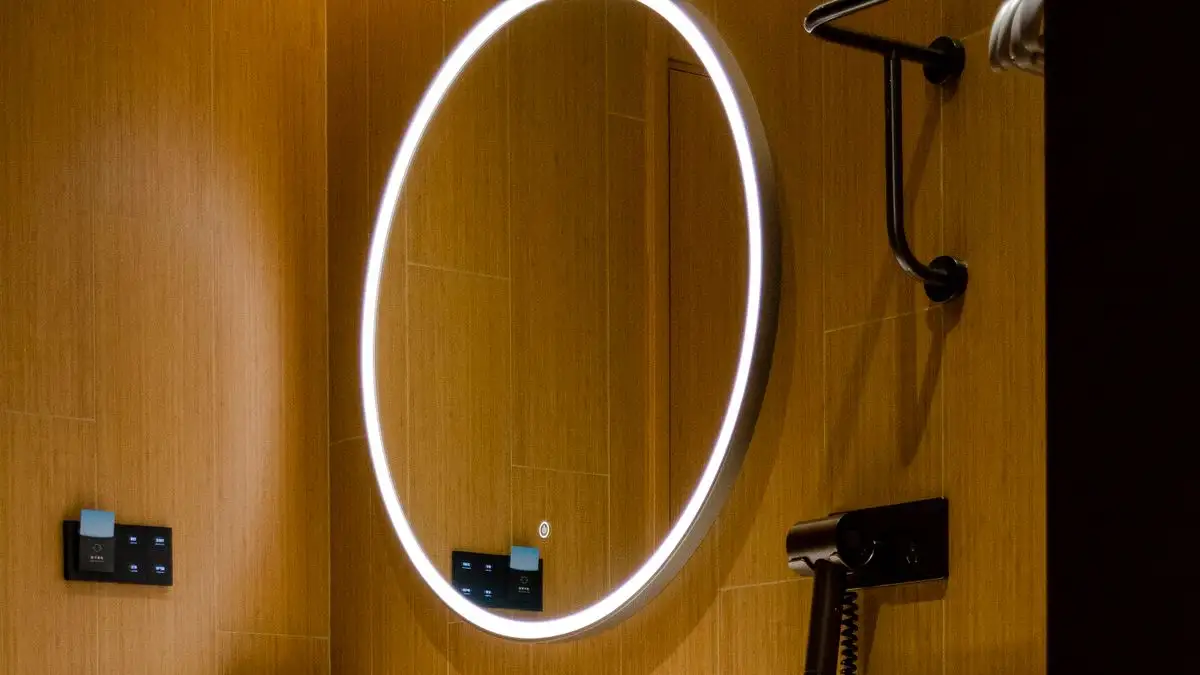
Stand at my sink with me at 6:40 on a Tuesday. The switch is on the wall behind your right shoulder. The only fixture in the room is a two-bulb bar bolted flat above the mirror, and one bulb has a gray ring around its base from running hot for a year. The light pools on the countertop beside the faucet and on the top of my head. My face is a silhouette with a bright forehead, and the mirror shows me that twice.
I spent longer than I want to admit believing the answer was more light. I bought brighter lamps. I cleaned the mirror with vinegar and a microfiber cloth until it was genuinely spotless. The room got brighter and my face stayed in the dark, because I was adding light to the same bad geometry. Light doesn't care how much of it there is if your own brow is standing between the source and your eyes.
Two things finally organized this for me.
The first is that a mirror doesn't make light. It shows you the light you already have, doubled, and it is honest about it. If the only source in the room sits above and behind your head, the mirror reflects a bright back and a dark front. That isn't a mirror problem. It's a where-is-the-light problem.
The second is that there is no such thing as "a bathroom light." There are wall-mounted fixtures, and each one is good at one job. A sconce is face light. A bar is even coverage across a wide mirror. A picture light is wall and art light. An under-cabinet strip is counter light. Once I started shopping by job instead of by finish, most of the confusion collapsed, because a fixture that is wrong for the face is often exactly right for the tile wall behind the tub.
Where the shadow falls (read the light before you buy)
Here's a test that takes ten seconds and settles more arguments than any showroom. Hold your phone at arm's length beside your head, roughly at eye height, flashlight on, aimed at your face. The shadows under your eyes and beside your nose disappear before you touch the brightness slider. Now hold the phone above your head, six inches out from the mirror. The raccoon eyes come straight back.
Same light. Same face. Different place.
So before I look at any fixture, I look at the shadow.
- Shadow under the brow and eyes: the source is too high, or it's mounted too close to the plane of the mirror, so it comes down at a steep angle your brow intercepts.
- Shadow under the nose and chin: the source is too low, or it's a single fixture centered dead in front of you, lighting the middle of the face and leaving the rest to reflection.
- Shadow down one side of the face: you have one lateral source and nothing on the other side. One sconce makes one shadow.
- No hard shadow anywhere but the whole room still reads gray and flat: that isn't a task problem. The mirror is reflecting a room with nothing in it. Another task fixture won't fix that; the walls need light.
Most people I've talked to skip this step and buy the same shape that failed the first time.
Wall sconces: aim first, finish later
A wall sconce can do three different jobs depending on which way it points, and that matters far more than whether it's brass or matte black.
An up-light washes the wall and lifts the whole room. It does nothing for your face, and it's the right call for a hallway or for the wall over a freestanding tub. A down-light gives you task light on the counter and on the top of your head, which is useful until the bare lamp glares back at your eyes; a shade that cuts off the sides fixes that. The one that earns its place beside a mirror is an up-and-down fixture, or a forward-throwing one whose shade stands off the wall so light comes out sideways, past the plane of your face.
Height is where people guess and where the guessing shows. I tape a mark at my eye level while I'm standing at the sink, and the fixture's center usually lands somewhere between that mark and a few inches above it. Exactly where depends on how far the shade projects off the wall and how tall the fixture is, which is why a number copied from someone else's bathroom so often disappoints. Shallow shade, higher mount. Deep shade, you can drop it.
And use two if there's wall space. Two sconces flanking a mirror cancel each other's shadows. One sconce just moves the shadow to the other cheek.
Vanity bars, and why the one above your mirror isn't working
The bar over the mirror is the most common fixture in an American bathroom and the most commonly misaimed. Bolted flat to the wall above the glass, it throws its cone down onto the top of your head instead of across your face. Two things fix it: length and standoff.
Length first. A bar much narrower than the mirror lights a band down the middle of your face and leaves the outer thirds to bounce light. I want the bar to run close to the full width of the mirror, and if I can't get that, I'd rather have two shorter bars than one short one centered.
Standoff second. Light has to get out past the mirror to reach you. A shade sitting an inch off the wall throws most of its output at the wall and your part. Something standing four or five inches off the wall, or carrying a forward-facing diffuser on a bracket, pushes light into the plane where your face actually is. Same lamp, same wattage, completely different result.
There's an honest limit here. A bar can't be mounted lower than the top of the mirror, so a tall mirror forces the fixture to start high. That's why tall glass with a single bar on top almost always needs help from the sides, and why a recessed medicine cabinet or a mirror running wall to wall can leave you with no good lateral option. In that case the compromise is a forward-throwing bar at the top edge, plus under-cabinet light to raise the overall level so the mirror has something better to reflect. It's a compromise. I'd rather say that than pretend a fixture exists that solves it cleanly.
Picture lights are wall lights, not face lights
A picture light is built to wash a wall or a piece of art from above, and it should be sized to the artwork rather than to the room. My working rule is roughly half the width of the framed piece, positioned so the strongest part of the beam lands on the upper third and fades before the bottom edge. Wider than that and you get a bright rectangle with a dark frame around it. Narrower and it becomes a spotlight.
In a bathroom, a picture light earns its place on the textured tile, the niche, the framed print over the toilet, the wall behind a freestanding tub. It adds the wall brightness that the mirror needs in order to reflect anything. What it will not do is light your face. It's above you and behind the mirror plane, so it lights your hair and the wall behind your head. Glossy tile under a picture light also throws a bright band straight into the mirror at eye level, which is worse than the dark you started with. Matte surfaces, or a fixture with a deeper hood, keep that under control.
Under-cabinet strips fix counter shadows, not mirror shadows
The principle is simple and it's the reason under-cabinet lighting works so well in kitchens: put the source between the task and the thing blocking the light. On a bathroom vanity with an upper cabinet, the cabinet is the blocker. A strip mounted under it puts light straight down onto the counter, so your hands don't cast a shadow over the shave kit, the contact lens case, or the tray of products.
It does not light your face, and it shouldn't be asked to. What it does do is raise the brightness at counter level, and the mirror reflects that, so the whole room reads lighter even though nothing changed above the sink. One trap: a polished countertop under a bare strip throws a hard bright line into the mirror at eye height. A diffuser on the strip softens it to a wash.
Stairs and hallways: the light has to land on something
This is the same lesson in a different room. Brightness isn't the metric; landing is. On a stair, I want down-throwing wall fixtures positioned so the light rakes across the treads and the wall beside them, because the nosing edge is what your foot and your eye both need. If the brightest spot in the stairwell is on the ceiling, the fixture is too high and the treads are sitting in shadow between pools of light.
Hallways work the same way. The goal is overlapping pools along the walking path with no dark gaps, spaced about an arm's reach apart, so your eyes aren't re-adjusting every few steps. Even beats bright.
Plug-in and rechargeable: the honest tradeoffs
A plug-in sconce or a rechargeable one means the light can go where the light is useful without new wiring. That's real value, especially in a rental or a bathroom where the walls are full of tile.
The tradeoffs are real too. A cord dictates placement unless you commit to a cord cover or route it behind something, and the outlet is rarely at eye height. Rechargeable fixtures dim as the charge drops, and plenty of them drift warmer as they dim, which changes what you see in the mirror by the end of the week. If you're doing makeup under one, charge it on a schedule or keep a second unit charged and swap.
What doesn't change is the geometry. A rechargeable sconce mounted eight inches too high throws the same bad shadow as a hardwired one. Place it where the light needs to land first, then work out the cord.
Check placement before you check the finish
Stand where you stand with the door closed and look at the shadow before you look at anything else. Run the phone test at your side and then overhead. Tape a mark at eye level on the wall beside the mirror. Measure the clear wall on each side: six to eight inches on both sides opens up sconces, and a mirror that runs wall to wall or a cabinet recessed into it points you toward a forward-throwing bar plus under-cabinet light. Match the width of any bar you're considering against the width of the mirror. And ask what the fixture does with light — up, down, both, forward — before you ask what it's finished in.
The finish question genuinely comes last. Brass, chrome, and matte black don't move a shadow an inch. I've watched people replace a perfectly good fixture because they didn't like the metal and end up with the exact same dark face, and I've watched an inexpensive strip under a cabinet change how a whole bathroom feels. Order of operations: which job, where does the light land, then what it looks like.