A rug pad should be cut 1 to 2 inches smaller than the rug on every side. That margin keeps the pad from peeking out at the edges, keeps the rug's border sitting flat on the floor, and gives the rug room to creep without dragging the pad into view. The two situations where a pad can match the rug's footprint are thin, low-pile rugs and high-traffic runners, and even then the pad has to be trimmed to the rug's exact outline, because one stray half inch at a corner is the thing everyone sees.
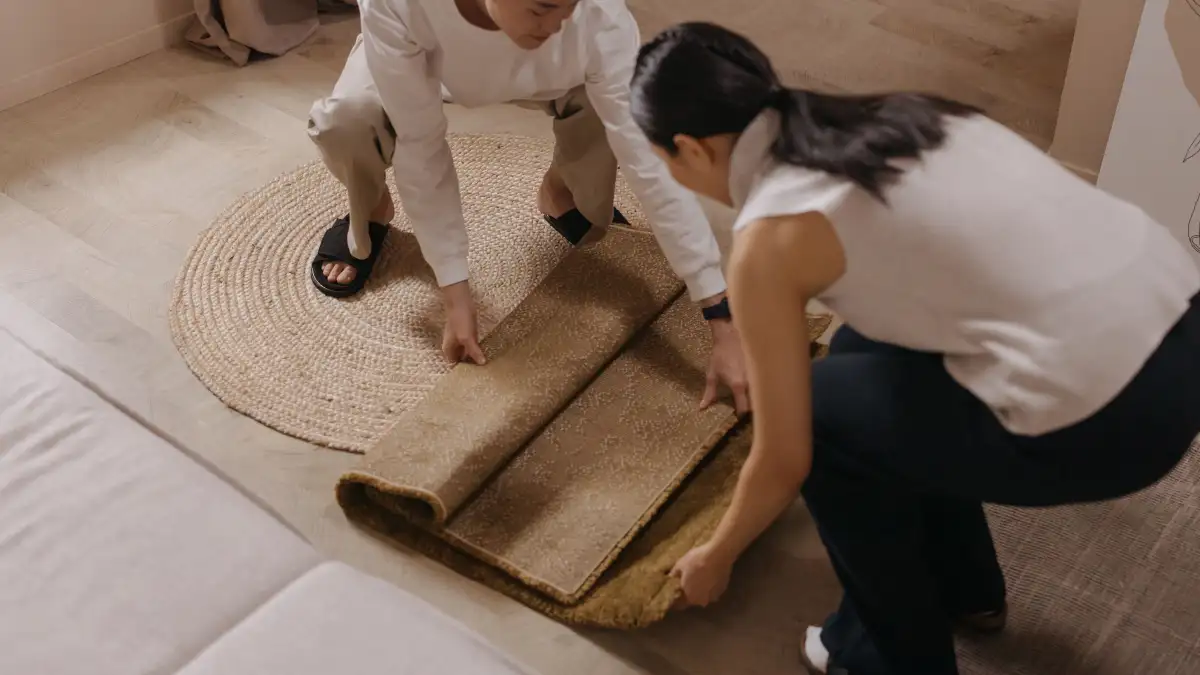
I've watched people get this wrong the same way every time, and it's almost never the measurement that fails. It's the assumption that smaller automatically means centered.
Here's the moment. The rug is down, the pad is under it, and someone steps back four feet and tilts their head. There it is: a soft gray crescent at the front corner, a tide line where the pad has crept out from under the binding. Nobody notices the two inches of missing pad under the middle of the rug. Everybody notices the one inch that shows.
Why the margin exists at all
The pad's cut edge is a step. Under the middle of a rug, that step is invisible — the pile bridges it. At the rug's edge, where the rug is only as thick as its binding, the step becomes a ramp, and the rug's corner rides up on it. That's the curl you see on cheap rugs in rental apartments, and it isn't the rug's fault.
There's a second reason, and it has less to do with looks. Rugs move. Wool walks in the direction of traffic, anything slick-backed walks on smooth flooring, and the pad is what absorbs that drift. Give the pad an inch or two of slack under the rug and a shift of half an inch changes nothing you can see.
And a pad that holds the rug still also saves the rug. Every time the rug slides, its backing grinds against the floor or against the carpet beneath it. Do that for a year and the backing abrades, the weave loosens at the corners, and the rug ages faster than its pile suggests. A pad that limits that friction is doing more long-term work than the cushioning everyone buys it for.
The margin isn't one number
Two inches is the right default for a 9x12 in a living room. It's not right for everything.
On a small mat — a 2x3 by the door, a bath-size rug — taking two inches off every side removes a real share of the pad's footprint, and you end up with a coaster floating under the middle of a rug that has nothing gripping its own corners. On those I go closer to an inch. Standard living-room sizes get 1.5 to 2. Something oversized, say 10x14 in a room with furniture on it, can take 2.5 with no downside, and the extra inch is cheap insurance.
For thin flatweaves and any rug in a hallway or entry where feet land on it constantly, a pad cut to the full footprint can be the better call. It has to be exact, though. That's not an eyeball job; you lay the pad on the rug, trace it, and cut inside the line.
Cutting it without ruining it
Chalk, a yardstick or a drywall square, kitchen shears for thin rubber pads, and a sharp utility knife with a fresh blade for felt. Cut with the pad face down on a hard floor — never on carpet. A soft surface lets the blade wander and you get a wavy edge, which shows worse than a straight edge that's slightly too wide.
One pass. Don't saw at it.
Then set the pad under the rug and compare it to the rug, not to the number you measured. The tape measure is where the error enters; the rug is the ground truth. And round the pad's corners just slightly while you're there. A sharp pad corner is a point load, and it pushes up through a thin rug faster than a straight edge does.
Floor type changes the pad, not the margin
On hardwood, tile, and vinyl plank, the pad has two jobs at once: hold the floor and hold the rug. A felt-and-rubber pad is the standard answer, and the orientation matters — rubber side down against the hard floor, felt up against the rug's backing. The rubber grips the floor, the felt grabs the rug.
On wall-to-wall carpet, the pad's job changes. The carpet is already cushioned, so you aren't adding softness, you're adding stability — and a thick pad in that spot can add instability instead. Think of the stack as two layers that can now shift against each other. A low-profile, high-friction pad is usually the right call on carpet; a mesh anti-slip underlay is another; and a heavy rug on a grippy carpet sometimes needs nothing at all. Watch the rubber, too. Aggressive rubber backing over wool carpet can pull fibers, and wool doesn't grow them back.
The sizing rule doesn't change with the floor. One to two inches in from every edge, regardless.
Thickness, doors, and the hinge side
This is where pad sizing stops being about the rug and starts being about the room.
Add pad thickness to rug pile and you have your stack height. Interior doors usually clear somewhere in the neighborhood of half an inch to three quarters, but that gap is not uniform around the swing — measure it at the hinge side, not at the middle of the arc. A door that sails over a rug at mid-swing can still scrape near the jamb, because that's where the door sits lowest to the floor as it comes around. If the rug has to live in a used doorway, a thinner pad under that edge, or keeping the rug clear of the arc entirely, beats fighting it.
A stiff door with a tight gap will shove the rug ahead of it. The rug fanns up, wrinkles, and then the wrinkles set, and no amount of steaming gets them out cleanly.
One more door rule: if there's a metal threshold strip at the opening, stop the pad before it. The pad lives entirely under the rug. There's no partial credit for a corner of pad peeking into a doorway.
Centering is not the same as sizing
People assume the pad goes in the middle. Often it shouldn't.
What you want is grip where the rug gets loaded and where it gets walked, and those are rarely the same place as the geometric center. A sofa sitting on one end of the rug means the weight is there. A wear path along one edge — a hallway runner, a rug between the bed and the door — means the push is there. Shift the pad toward the load or the traffic. You still keep a margin on all four sides; you just don't have to keep equal margins.
The test that settles it
Crouch down to rug level and sight along the edge. Then stand up and look from the doorway you'd actually walk through. Then, the real test, put a foot on a corner and pivot.
If nothing shows and nothing slides, the size is right. If the rug moves and the pad stays put, you have the friction pairing you want. If the pad comes with it — if it emerges from under the edge like a tongue — then either the pad is too big, the pad and rug don't grip each other, or the pad's rubber is grabbing the floor harder than the felt is grabbing the rug. That last one is common and easy to misdiagnose as a size problem.
The size question is really a question about what the pad is for. Not softness. Position. A pad cut slightly smaller than the rug, trimmed clean, thin enough to sit under a door and grippy enough to keep the rug from wandering, does the whole job.