Mixing more than two decorating styles in a small room backfires because the eye has nowhere to rest. Every added style brings its own shapes, materials, and colors, and a small room has no distance with which to separate them: all of it lands in one sightline, so the room reads as busy even when each individual piece is good on its own. The fix is arithmetic more than taste. Cap the room at two styles, repeat one color at three different scales, size every piece to the room's dimensions rather than to the style's typical furniture, and leave genuine emptiness instead of filling the last available gap.
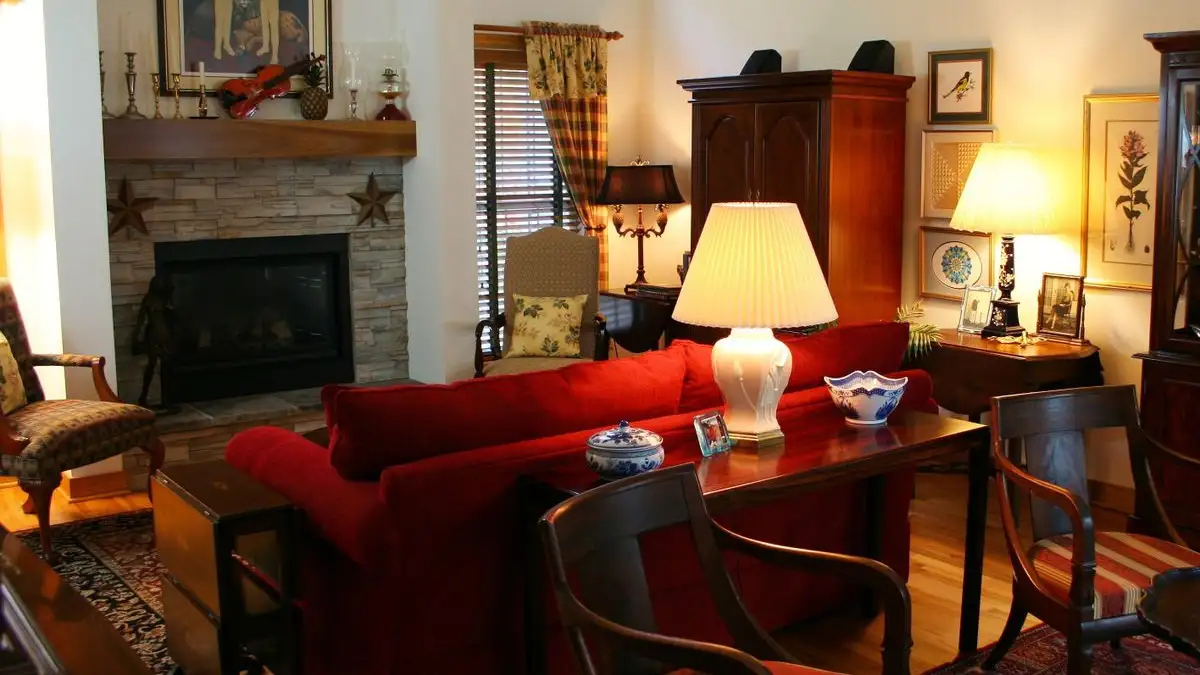
I do one thing in every small room I walk into, and it has nothing to do with taste. I stand in the doorway and count. Not the number of objects, the number of families of objects: how many leg shapes touch the floor, how many wood tones are visible from that one spot, how many different metal finishes show up across hardware, a lamp, a curtain rod. Three or four answers usually means the room is fine. Seven or eight means the room is arguing with itself, and no amount of rearranging fixes it, because the problem is plural.
Stand in that doorway with me and you will feel the mechanism. You are not comparing that chair to that mirror. You are comparing both of them to each other in the same glance, and the glance is short because the room is short. A ten-by-twelve living room gives you maybe eight feet of sightline from the opening. In a twenty-foot room, the eye travels far enough between two styles to forget the first one before it arrives at the second. In a small room, they arrive together. That simultaneity is the whole problem, and it is why the rules below are about quantity and proportion rather than about which style is better.
Two styles, and the doorway count
Two is a working limit, not a moral rule. What makes it work is that it lets you have contrast without breaking the count.
Give one style the fixed, expensive, hard-to-swap elements: the sofa, the rug, the curtains, the main wood pieces. That is your structure. Let the second style arrive in smaller, cheaper, movable things, and make it the quieter of the two. A rustic room can absorb a few clean modern lines. A modern room can absorb a few rough rustic textures. What neither can absorb is two styles that both shout, because then nothing in the room is background and the eye has no lower gear to drop into.
There is a version of this that is not obvious from photos. Some style pairs are already one family. Mid-century and Scandinavian share a low profile and a tapered leg. Traditional and transitional share a formality level. When two styles sit near each other on that axis, they read as one vocabulary and your count is effectively one. Pairing across the gap, something very formal next to something very casual, is the combination that actually breaks, and it breaks faster in a small room than in a large one.
Pick one color and spend it three times
I count colors the same way I count leg shapes, and the count matters more than the color. Choose one color and repeat it at three noticeably different scales: once large, once medium, once small. A large soft surface like a rug or curtains, a mid-size upholstered or textile element, then two or three small accents. When the same color shows up at three scales, the eye links the pieces into a group, and a room made of groups feels organized instead of scattered.
The other half of this is value contrast. High contrast between light and dark creates hard edges, and hard edges are what tell the eye where the walls are and how close they are. Keep the base colors of both styles within a narrow range of light and dark, and the room stops announcing its own boundaries. That is the part people miss: it is not one color that makes a small room feel larger, it is the absence of fragmentation. Two styles, one palette.
Scale belongs to the room, not the style
This is where mixed styles go wrong most often, and it has nothing to do with the styles at all. Every style comes with a typical scale, and that scale assumes a typical room. A deep-armed sofa is deep in any style. A chunky farmhouse table is chunky in any palette. When you import a style's furniture at its native size into a small room, you have added bulk on top of the visual competition, and the room loses twice.
The proportions I actually check
- The main seating piece should not span the wall it sits against. Two-thirds of that wall is a reasonable ceiling; anything close to full width turns the sofa into a wall.
- Depth matters more than length in a small room. Six extra inches of seat depth eats floor you cannot get back, and floor is what reads as space.
- A coffee table around two-thirds the sofa length, at roughly seat-cushion height, keeps the middle of the room open at eye level even when it is physically occupied.
- Get the largest rug that fits, then leave six to twelve inches of bare floor visible at the edges. That border keeps the room's true dimensions legible instead of turning the floor into an unbroken field.
- Between a coffee table and seating, eighteen inches is passable and twenty-four is comfortable. Main walkways want closer to thirty. If you are under those numbers, the piece is the wrong piece, regardless of style.
Empty space is a finish, not a leftover
In a small mixed-style room, negative space is doing structural work. It is the only thing separating your two styles, since distance is not available. Empty wall beside a single piece of art is not wasted wall; it is the margin that lets the art register as deliberate.
I also count how many objects touch the floor. Anything with a footprint reads as mass, and mass is what you are rationing. Keep floor-contact pieces to the smallest number that still supports how the room actually gets used, and move everything else up or out.
Use the vertical, protect the floor
Height is free space. Curtains hung at the ceiling line and running full length pull the eye up and make the window wall read taller, and they cost no floor area at all. Wall-mounted shelving does the same thing, with one caution: past about ten or twelve inches of depth, a shelf stops reading as a shelf and starts reading as a cabinet, and it begins to press into the room. Shallow and high is the version that works.
A tall lamp, a tall plant, a vertical stack of art, all of it trades floor for air. In a room where two styles are already competing for attention, sending some of that attention upward is the cheapest relief available.
Multi-functional pieces only work if their lines are quiet
A storage ottoman, a bench with baskets tucked under it, a sofa bed, a table that doubles as a desk: these pieces solve a real problem, because they let one object serve two functions without adding another footprint. They are also the most common way a small room gets heavier instead of lighter.
Multi-functional furniture tends to be chunkier than single-purpose furniture, because the mechanism has to live somewhere. That means it adds bulk even as it saves space. The trade only pays off when the piece has simple lines and a clean base: no skirt, no turned legs, no visible hardware, no busy upholstery. If the multi-functional piece is visually complicated, you have bought an extra function and paid for it in clutter, and clutter is the thing you were trying to reduce.
When the rule bends
Two styles is a rule about rooms that have to hold several jobs at once. A small bedroom, doing one job, tolerates more mixing than a small living room that is also the dining room and the office. The more functions a room carries, the tighter the style count needs to be, because each function already brings its own objects and its own visual noise.
If you genuinely cannot give up a third style, isolate it rather than spreading it. Keep it behind a door, or on the far side of a threshold, so the doorway count stays at two for the room you actually sit in. And if the room is a pass-through with two openings, count from both of them, not just the one you usually enter. The count has to hold from every place you stand.
That is the test, and it takes about four seconds. Stand in the last doorway you would walk through, look, and count the families of shapes and colors. If the answer is two, the room is working and you can go sit down. If it is more than two, the mixed styles are not adding character. They are subtracting space, and no new piece is going to get it back.